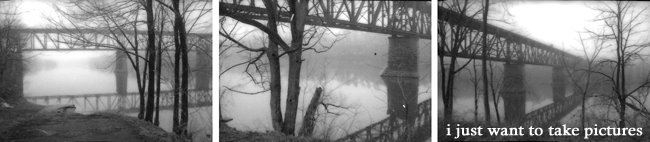
I have had these quotes written down since the beginning of M3 and they still ring true to my opinion of photography, its benefits, limits and relationships to architecture. The explanations of the quotes are not very eloquent - they were just a way for me try to explain (to myself) what it was the quotes meant to me.
a.
a.
on photography as event
“Even so, photography offers the possibility to freeze aspects of reality of architecture and light that might vanish when contemplated in the flesh. It is also true that through photographs fiction is greater, although reality might be more surprising.”
- Elias Torres
"Although the event is always something that takes place in a global disorder devoid of meaning, this happy moment - at times accidental, at times the result of a willing intellect - constitutes an outstanding instant in a constant flux, a harmonious, polyphonic chord in a situation of permanent transition.”
- Ignasi de Sola-Morales
on photography as trace/evidence
Though Sola-Morales is referring to an event and the architecture of an event, I find that this quote defines photography very accurately and, in a way, echos the idea behind Torres' quote. After all, a photograph is just a happy moment captured from a stream of constant flux and chaos. That instant is then transferred to a place of permanent transition where the instant will exist forever and never change.
on photography as trace/evidence
"As distinct from symbols, indexes establish their meaning along the axis of a physical relationship to their referents. They are the marks or traces of a particular cause, and that cause is the thing to which they refer, the object they signify."
- Rosalind E. Krauss
The photograph is an index or referent of what existed at the moment that the photograph was taken. It is a footprint or trace left by the photographed object, event or person. Just because a photograph is an accurate trace, however, does not make it true. As Barthes says previously, it is simply proof that something existed.
on the limits of photography
“The decline of narrative painting in the past century has been ascribed in large part to the rise of photography, which “relieved” the painter of the necessity of story telling. This is curious, since photography has never been successful at narrative. It has in fact seldom attempted it… The heroic documentation of the American Civil War by the Brady group, and the incomparably larger photographic record of the Second World War, have this in common: neither explained, without extensive captioning, what was happening. The function of these pictures was not to make the story clear, it was to make it real.”
- John Szarkowski
A photograph without words or captions does not tell a story; it is only a glimpse into a moment, and without captions the explanation of that moment is not any clearer to us once we have seen the image. The photograph is only evidence that the moment occurred.


No comments:
Post a Comment