When I was interviewed for the program at the University of Waterloo School of Architecture, I was asked the obvious question: Why do I want to study architecture? I barely had to think about it, and I'm not quite sure where the answer came from, but it was what I felt at the time, and believe I would still answer that question similarly if asked today, seven years later.
I said, I wanted to study architecture because I believed "buildings tell stories". Architecture is the result and response of a culture, a history, and a specific time-frame within that history. It tells the story of the architect and all those involved who help shape and design it.
Little did I know, the man asking that question was the school's Iconography professor and the first book he would assign to our incoming first year class would be "the Storyteller".
I have this same reaction to photography, though, now, I would change the wording of my answer. Buildings don't tell us anything, they show us, just like photos. Without captions, a photograph gives you no information - you can't even tell what year or what country it was taken, let alone under what circumstances and what it meant to take that photo or be in the photo itself.
Both architecture and photography are utilitarian practices - architecture provides us with buildings, cities, homes, entire environments to live and work in, while photography documents that life for us, whether to remember, experience or share it. But, at the same time, these two practices enhance our lives and allow us to share with others, what we as a society consider important or worth documenting.
Let's look at architecture for the time being, in the context of my site, Galt, Ontario. The steeples of the town rise higher than anything along the river, creating a beautiful cityscape punctuated with spires. The importance of this was immense at the time of the building of the churches - they were the most important buildings within their Christian community and therefore, nothing could rise above them in hierarchy or in physical form. Recently, it was passed that two new condo towers slated to be built along the river's edge, had permission to, indeed, rise above the church steeples.
Another change within the structure of the town, is the use of existing buildings and the overall use of the town. Dubbed the "Manchester of Canada" in the latter part of the nineteenth century, Galt produced textiles, machine parts and ammunition at a calibre matched by no other town in the country, even her quickly expanding sister-city to the north, Berlin (Kitchener). Her product was shipped to Europe, assisting the British troops during the Crimean War, and even as far as Asia and India. After the industrial revolution & the cessation of passenger train service between Galt and the surrounding areas, the town's buildings slowly began falling into decay.
All is not lost, however, since many of these buildings are now being reinforced and renovated, their old names repainted in crisp, black and white paint on the side, "Tiger Mills" or "The Galt Knife Factory". They have been given new life as condominiums, with 'historical presence and meaning'.
I began photographing this town for different reasons. It made sense practically - I live here and have easy and quick access to my site, and being constantly immersed in the town gives me an insider’s view and perspective. The other reason I began photographing Galt was for the sheer fascination I had with it. The old buildings, the people, the river – it all made for an incredible history, which I read, learned and became very proud of.
I wanted to tell the story of Galt, though for the longest time, was very confused as to what that story was (something I have yet to pin point, though I feel I am getting closer). Was I telling the story of its past and so photographing only the decaying buildings and those which have managed to last all these years? Or was I photographing the story of its future? With the help of the School of Architecture, the Business Improvement Program initiated by the mayor and the whisper of the Venice Biennale making its way across the Atlantic to the small town, Galt was slowly being revived. For the first time in decades, there was a very hopeful future for the town that, in the 70s, disappeared into the large and anonymous collection of other lost towns, known as Cambridge, which in turn was swallowed up by “The Waterloo Region”. The identity, which Galt had worked so hard to achieve and maintain for almost 200 years, disappeared.
I finally settled on simply photographing. I would stop looking for a justification for picture taking, besides my desire to do so, as well, I would stop trying to take an analytical and structured approach to the task of documenting the town. I began to wander streets, not caring particularly where I ended up or how long I was out, as long as I had enough film.
My decision to use 35mm and 120mm film cameras and not digital equipment was automatic. My love of the craft itself drove me to make the decision, though considering the subject is Galt, once a prospering industrial town, it seems very appropriate. It is a manner of production that is based on a meticulous method, utilizing equipment & materials that have not been the primary choice of individuals & industry in decades. This system only succeeds with many man hours, the use of one’s hands (and eyes) and ultimately on skill (which comes only with hours and hours of practice – in the beginning it’s mainly guesswork).
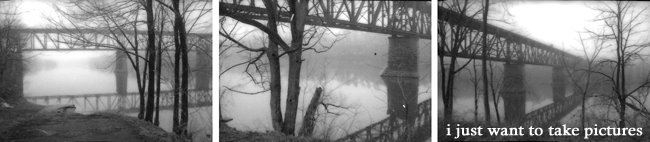
Recently, as the deadline for my thesis approaches, I was directed to begin ‘grouping’ my images. I had attempted such an exercise in a blog entry and it was considered very successful and a good route to take to really identify the patterns in my work. I was pleasantly surprised that photographs, which I had taken months previously, fit in very nicely with those taken just days before – there seems to be a system I am employing, even though I am note aware, yet, of what that system is. As I continued to group the photos, a cohesiveness began to evolve – photos, which I thought were interesting but not anything special, took on a brand new life when placed beside another such, non-descript photo. The power of the pair or group could not be ignored and it is this route that I am taking, attempting to find themes and motifs within my photographs to better understand what story I am trying to tell.
a.
I said, I wanted to study architecture because I believed "buildings tell stories". Architecture is the result and response of a culture, a history, and a specific time-frame within that history. It tells the story of the architect and all those involved who help shape and design it.
Little did I know, the man asking that question was the school's Iconography professor and the first book he would assign to our incoming first year class would be "the Storyteller".
I have this same reaction to photography, though, now, I would change the wording of my answer. Buildings don't tell us anything, they show us, just like photos. Without captions, a photograph gives you no information - you can't even tell what year or what country it was taken, let alone under what circumstances and what it meant to take that photo or be in the photo itself.
Both architecture and photography are utilitarian practices - architecture provides us with buildings, cities, homes, entire environments to live and work in, while photography documents that life for us, whether to remember, experience or share it. But, at the same time, these two practices enhance our lives and allow us to share with others, what we as a society consider important or worth documenting.
Let's look at architecture for the time being, in the context of my site, Galt, Ontario. The steeples of the town rise higher than anything along the river, creating a beautiful cityscape punctuated with spires. The importance of this was immense at the time of the building of the churches - they were the most important buildings within their Christian community and therefore, nothing could rise above them in hierarchy or in physical form. Recently, it was passed that two new condo towers slated to be built along the river's edge, had permission to, indeed, rise above the church steeples.
Another change within the structure of the town, is the use of existing buildings and the overall use of the town. Dubbed the "Manchester of Canada" in the latter part of the nineteenth century, Galt produced textiles, machine parts and ammunition at a calibre matched by no other town in the country, even her quickly expanding sister-city to the north, Berlin (Kitchener). Her product was shipped to Europe, assisting the British troops during the Crimean War, and even as far as Asia and India. After the industrial revolution & the cessation of passenger train service between Galt and the surrounding areas, the town's buildings slowly began falling into decay.
All is not lost, however, since many of these buildings are now being reinforced and renovated, their old names repainted in crisp, black and white paint on the side, "Tiger Mills" or "The Galt Knife Factory". They have been given new life as condominiums, with 'historical presence and meaning'.
I began photographing this town for different reasons. It made sense practically - I live here and have easy and quick access to my site, and being constantly immersed in the town gives me an insider’s view and perspective. The other reason I began photographing Galt was for the sheer fascination I had with it. The old buildings, the people, the river – it all made for an incredible history, which I read, learned and became very proud of.
I wanted to tell the story of Galt, though for the longest time, was very confused as to what that story was (something I have yet to pin point, though I feel I am getting closer). Was I telling the story of its past and so photographing only the decaying buildings and those which have managed to last all these years? Or was I photographing the story of its future? With the help of the School of Architecture, the Business Improvement Program initiated by the mayor and the whisper of the Venice Biennale making its way across the Atlantic to the small town, Galt was slowly being revived. For the first time in decades, there was a very hopeful future for the town that, in the 70s, disappeared into the large and anonymous collection of other lost towns, known as Cambridge, which in turn was swallowed up by “The Waterloo Region”. The identity, which Galt had worked so hard to achieve and maintain for almost 200 years, disappeared.
I finally settled on simply photographing. I would stop looking for a justification for picture taking, besides my desire to do so, as well, I would stop trying to take an analytical and structured approach to the task of documenting the town. I began to wander streets, not caring particularly where I ended up or how long I was out, as long as I had enough film.
My decision to use 35mm and 120mm film cameras and not digital equipment was automatic. My love of the craft itself drove me to make the decision, though considering the subject is Galt, once a prospering industrial town, it seems very appropriate. It is a manner of production that is based on a meticulous method, utilizing equipment & materials that have not been the primary choice of individuals & industry in decades. This system only succeeds with many man hours, the use of one’s hands (and eyes) and ultimately on skill (which comes only with hours and hours of practice – in the beginning it’s mainly guesswork).
Recently, as the deadline for my thesis approaches, I was directed to begin ‘grouping’ my images. I had attempted such an exercise in a blog entry and it was considered very successful and a good route to take to really identify the patterns in my work. I was pleasantly surprised that photographs, which I had taken months previously, fit in very nicely with those taken just days before – there seems to be a system I am employing, even though I am note aware, yet, of what that system is. As I continued to group the photos, a cohesiveness began to evolve – photos, which I thought were interesting but not anything special, took on a brand new life when placed beside another such, non-descript photo. The power of the pair or group could not be ignored and it is this route that I am taking, attempting to find themes and motifs within my photographs to better understand what story I am trying to tell.
a.


