After that little rant, here is what I have come up with to date (so you know I haven't completely gone off the handle and am crying in a fetal position on my bed)... it's pretty primitive and contains quite a few 'unknowns' but seems to be taking form.
Title: Unknown [previous title "The Texture of a Town"]
Abstract: the explanation of the relationship between
architecture - collective memory - storytelling - photography...
or is it...
collective memory - architecture - photography - storytelling?
And though it is linear, I can see how this can also become something cyclical
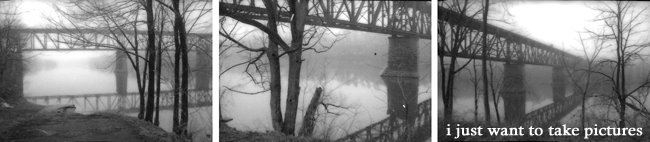
Images: My aim is for 60 images, organized in groups or on their own, no captions or explanations, only titles such as "Triptych #1 (train bridge)" or "Untitled #1 (Porch)"... whether or not I will be able to produce quite this many is still to be determined.
Quote: Overarching quote that combines all three ideas - photography, architecture & storytelling for the beginning of the thesis and then one on each topic at the beginning of each following chapter. Here is a possibility for the overarching quote:
Chapter 1 | Storytelling
Quote: Maybe from the storyteller or Bachelard (Bachelard my be far-fetched & not really pertinent)
I would also like to include one or more stories from Eavesdroppings... maybe throughout this section would be a good place for it... or in the introduction, when speaking of storytelling and Galt and what not....
Chapter 2 | Photography
Quote: I am thinking either Szarkowski or Klein
Chapter 3 | Architecture
Collective memory is included in this ... or should Collective Memory have a chapter all on its own? It seems to be the topic the binds all the others together.
Quote: Aldo Rossi on collective memory or permanence, maybe? I'm re-reading it right now, so we'll see... also this is clearly the most uknown chapter... surprise!
[I'm not sure if I will make these chapter titles any more.... profound, inspirational or descriptive.. for now I'm sticking with the simplicity of it all.]
Conclusion: I'll let you know when I know.
Addendum: If I manage to get an exhibition space for July, the plan is to talk to the people that come in and ask them if the photos make them recall any stories, events, memories etc. I would like to then include these stories in the back of the thesis along with a small image of the photo they are refering to. I would also like to inlude images of the exhibition... or is that too much?
Appendix: I am considering the idea of including my daybook, or excerpts from it, in this section. Perhaps a few photo 'constructions'. I'm not sure if this is necessary (or even beneficial) yet, so we'll see.
Any thoughts?
Title: Unknown [previous title "The Texture of a Town"]
Abstract: the explanation of the relationship between
architecture - collective memory - storytelling - photography...
or is it...
collective memory - architecture - photography - storytelling?
And though it is linear, I can see how this can also become something cyclical
Images: My aim is for 60 images, organized in groups or on their own, no captions or explanations, only titles such as "Triptych #1 (train bridge)" or "Untitled #1 (Porch)"... whether or not I will be able to produce quite this many is still to be determined.
Quote: Overarching quote that combines all three ideas - photography, architecture & storytelling for the beginning of the thesis and then one on each topic at the beginning of each following chapter. Here is a possibility for the overarching quote:
- Even so, photography offers the possibility to freeze aspects of reality of architecture and light that might vanish when contemplated in the flesh. It is also true that through photographs fiction is greater, although reality might be more surprising (Elias Torres).
Chapter 1 | Storytelling
Quote: Maybe from the storyteller or Bachelard (Bachelard my be far-fetched & not really pertinent)
- I was deeply moved by the thought of that being, those beings, in the unhealthy forests of eastern Cusco and Madre de Dios, making long journeys of days or weeks, bringing stories from one group of Machiguengas to another and taking away others, reminding each member of the tribe that others were alive, that despite the great distances that separated them, they still formed a community, shared a tradition and beliefs, ancestors, misfortunes and joys: the fleeting, perhaps legendary figures of those habladores who - by occupation, out of necessity to satisfy a human whim - using the simplest, most time-hallowed of expedients, the telling of stories, were the living sap that circulated and made the Machiguengas into a society, a people of interconnected and interdependent beings (Vargas Llosa, 93).
- [Fire] links the small to the great, the hearth to the volcano, the life of a log to the life of a world (Bachelard, Psychoanalysis of Fire).
I would also like to include one or more stories from Eavesdroppings... maybe throughout this section would be a good place for it... or in the introduction, when speaking of storytelling and Galt and what not....
Chapter 2 | Photography
Quote: I am thinking either Szarkowski or Klein
- A picture is taken at 1/125 of a second. What do you know of a photographer's work? 100 photographs? Let's say 125? Well that's a body of work. That comes to all told one second. Let's say more like 250 photographs. That would be a rather large body of work. And that would come to two seconds. The life of a photographer, even a great photographer, as they say... two seconds (Klein, Contact).
- The function of these pictures was not to make the story clear, it was to make it real. (Szarkowski).
Chapter 3 | Architecture
Collective memory is included in this ... or should Collective Memory have a chapter all on its own? It seems to be the topic the binds all the others together.
Quote: Aldo Rossi on collective memory or permanence, maybe? I'm re-reading it right now, so we'll see... also this is clearly the most uknown chapter... surprise!
[I'm not sure if I will make these chapter titles any more.... profound, inspirational or descriptive.. for now I'm sticking with the simplicity of it all.]
Conclusion: I'll let you know when I know.
Addendum: If I manage to get an exhibition space for July, the plan is to talk to the people that come in and ask them if the photos make them recall any stories, events, memories etc. I would like to then include these stories in the back of the thesis along with a small image of the photo they are refering to. I would also like to inlude images of the exhibition... or is that too much?
Appendix: I am considering the idea of including my daybook, or excerpts from it, in this section. Perhaps a few photo 'constructions'. I'm not sure if this is necessary (or even beneficial) yet, so we'll see.
Any thoughts?


