Tuesday, May 19, 2009

In light of our chat....

I have realized all the benefits of chatting with my colleagues at the school, in groups or one on one about the issues or dilemmas we are facing with our theses. It is amazing how much I have in my head, that hasn't been verbalized. Or I don't realize I know it unless I am asked a specific question and think I am blatantly making up an answer when all of a sudden it makes so much sense. I had a great chat with Vicky the other day over coffee, and hopefully our chat helped her as much as it helped me... afterwards I went through my notes and made a list of all the questions that I need to answer for myself to really help shape my thesis. Or some questions might make me realize that certain answers aren't important in regards to my thesis.
a.

Why do I have this strong idea about ‘no captions’ – about allowing the viewer, to choose, for himself, what the photograph means, is ‘saying, is of?
  • Does someone write about this relationship?
  • What do I think will change if I have captions?
I seem to have a very strong idea bout the relationship of the viewer and the photo
  • Where does this idea come from? (Sontag, Barthes?)
  • Will the experiences of the viewer change what he/she sees in my photo?
  • Will the conditions under which he see it affect his impression?
  • Does it remind him/her of a place/experience?
*What is the relationship (if there is one) between the viewer and the photographer? (Sontag & Barthes)

What is important in the ‘system’ of my photo-taking?
  • Wandering aimlessly vs. rigorous & thorough planning/exploration
  • How can I incorporate this ‘wandering’ idea into the thesis?
  • Am I getting too rigid with the structure of the thesis? (three parts: stories, pictures, buildings)
  • Should it be a flowing, wandering narrative/story/exploration?
What does it mean for the picture that it can be interpreted in many different ways?
  • What is different about pictures today?
  • How has that changed the way someone views an image?
Craft: Why manual darkroom work?
  • There is a certain personal relationship that is developed with each photo
  • The ‘building’ of each picture requires, testing, retesting, exploration, skill, observation and most of all patience
  • Define craft or craftsmanship
  • How is developing ‘physically’ w/ hands, different than using a computer digitally?
  • What is it about the creation of something w/ our hands?
  • Talk about the physical connection to the medium
  • Which part of the brain is active when this occurs?
As a whole, what are my photographs?
  • They are series of fragments of the city
  • Glimpses of well known and little known areas
  • They are an exploration of the town
  • Small ‘key map’ with location?
  • Does this benefit the viewer, the photograph?
The thesis is a photographic exploration/research of the town of Galt. (??? Is this it?)
  • Define a better thesis statement. In one sentence, what is my thesis?
Looking at the photos:
  • What are some recurring patterns?
  • List them
  • Look at each photograph and determine what it is about
  • Why does it work alone? Why doesn’t it?
  • Why is it that two (or three or more) photos are grouped together?
  • How does this change how these photos are seen?
  • What are some benefits to doing it this way?
  • Explain this by referring to specific images
  • Talk about mood/tone of a photo
  • What are the photos saying/showing us in terms of the city?
  • What will people walk away with after seeing the pictures?
  • Will they learn something?
  • What am I trying to tell/show them?
  • If this is a research of the city, what have I learned?
Make a matrix of photographs
  • Subject matter, composition (1/3, 2/3, 1/2, symmetrical), secondary & tertiary objects, direction of lines, sun angle/light, tone, texture
  • Map out where I have taken the photos

Monday, May 11, 2009

Structure

After that little rant, here is what I have come up with to date (so you know I haven't completely gone off the handle and am crying in a fetal position on my bed)... it's pretty primitive and contains quite a few 'unknowns' but seems to be taking form.

Title: Unknown [previous title "The Texture of a Town"]

Abstract: the explanation of the relationship between
architecture - collective memory - storytelling - photography...
or is it...
collective memory - architecture - photography - storytelling?
And though it is linear, I can see how this can also become something cyclical

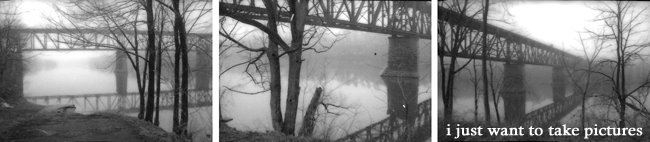
Images: My aim is for 60 images, organized in groups or on their own, no captions or explanations, only titles such as "Triptych #1 (train bridge)" or "Untitled #1 (Porch)"... whether or not I will be able to produce quite this many is still to be determined.

Quote: Overarching quote that combines all three ideas - photography, architecture & storytelling for the beginning of the thesis and then one on each topic at the beginning of each following chapter. Here is a possibility for the overarching quote:
  • Even so, photography offers the possibility to freeze aspects of reality of architecture and light that might vanish when contemplated in the flesh. It is also true that through photographs fiction is greater, although reality might be more surprising (Elias Torres).
Introduction: We'll see....

Chapter 1
| Storytelling
Quote: Maybe from the storyteller or Bachelard (Bachelard my be far-fetched & not really pertinent)
  • I was deeply moved by the thought of that being, those beings, in the unhealthy forests of eastern Cusco and Madre de Dios, making long journeys of days or weeks, bringing stories from one group of Machiguengas to another and taking away others, reminding each member of the tribe that others were alive, that despite the great distances that separated them, they still formed a community, shared a tradition and beliefs, ancestors, misfortunes and joys: the fleeting, perhaps legendary figures of those habladores who - by occupation, out of necessity to satisfy a human whim - using the simplest, most time-hallowed of expedients, the telling of stories, were the living sap that circulated and made the Machiguengas into a society, a people of interconnected and interdependent beings (Vargas Llosa, 93).
  • [Fire] links the small to the great, the hearth to the volcano, the life of a log to the life of a world (Bachelard, Psychoanalysis of Fire).
Ideas: Narrative vs. Imagery, the importance/use of storytelling in history (not too anthropological), personal accounts (the theory of architecture as storyteller)

I would also like to include one or more stories from Eavesdroppings... maybe throughout this section would be a good place for it... or in the introduction, when speaking of storytelling and Galt and what not....

Chapter 2 | Photography
Quote: I am thinking either Szarkowski or Klein
  • A picture is taken at 1/125 of a second. What do you know of a photographer's work? 100 photographs? Let's say 125? Well that's a body of work. That comes to all told one second. Let's say more like 250 photographs. That would be a rather large body of work. And that would come to two seconds. The life of a photographer, even a great photographer, as they say... two seconds (Klein, Contact).
  • The function of these pictures was not to make the story clear, it was to make it real. (Szarkowski).
Ideas: Pattern, the struggle of narrative through photography, photography as marks, traces or footprints.

Chapter 3 | Architecture
Collective memory is included in this ... or should Collective Memory have a chapter all on its own? It seems to be the topic the binds all the others together.
Quote: Aldo Rossi on collective memory or permanence, maybe? I'm re-reading it right now, so we'll see... also this is clearly the most uknown chapter... surprise!

[I'm not sure if I will make these chapter titles any more.... profound, inspirational or descriptive.. for now I'm sticking with the simplicity of it all.]

Conclusion: I'll let you know when I know.

Addendum: If I manage to get an exhibition space for July, the plan is to talk to the people that come in and ask them if the photos make them recall any stories, events, memories etc. I would like to then include these stories in the back of the thesis along with a small image of the photo they are refering to. I would also like to inlude images of the exhibition... or is that too much?

Appendix: I am considering the idea of including my daybook, or excerpts from it, in this section. Perhaps a few photo 'constructions'. I'm not sure if this is necessary (or even beneficial) yet, so we'll see.

Any thoughts?

Why........

I was having a conversation with a colleague about her thesis the other day. In short, it is an incredible endeavour to design housing in a third world country based on the distribution of water, helping those displaced by war and other causes from their vilalges begin a new life in the city. The whole thing makes perfect sense. It uses a practical system that could be implemented over time, helping people better their quality of life.

These are the kinds of theses that could change lives.

And then I think of mine and I try to figure out what the point of it is... besides to earn a degree and to explore photography as it pertains to the architectural world around me. What am I contributing? To the school.. to architecture as a profession... to Galt? It seems that most people at the school see a problem, research on how they're going to fix it, and spend the next year designing a possible solution - as they see it, trying to make the world better.

Why do I always decide that I am going to do something 'different'? I get some crazy-ass idea that I am going to spend a year-and-a-half taking photos and run with it. My thesis hasn't really even figured out if it's a research thesis or some sort of convoluted 'design' thesis.

Sometimes, I frustrate myself with my stubbornnes to cause trouble (mainly for myself) and go against the norm. (Clearly today is one of those days).

I am learning to continually remind mysel of Don's statment: It's like chocolate. The world doesn't need it, but would be poorer without it.

That'll have to do. My thesis is chocolate. It's too late to go questioning the entire purpose of my thesis now. Or my entire purpose at the school. I'll save that for therapy.

Sunday, May 10, 2009

Eavesdroppings: Stories from Small Towns When Sin Was Fun

The preface – this thing – is the toughest part of a book to write because it has to account for what follows: the selection of personal experiences and the experiences of acquaintances, narrated without moral or political purpose, recalling, for fun more than anything else, the humorous side of solemn or outrageous evens in the legends of small towns.
I’ve used the real names of all persons involved which, I trust, will lend the stories some historical credence.
Digressions, I must admit, became a problem. While trying to focus on local events, I wound up recounting the extraction of a beer glass from a man’s rectum in the emergency ward of a Toronto hospital, and the flight of a Salvation Army bass drum through the show window of a gay bar in San Francisco. However, digressions of this sort are unavoidable when one considers what matheaticians tell s – that all people and the events they are involved in are at most only six degrees removed.
It’s the small-world effect. We are all connected, and I assume that the stores related here, if pursued further, would connect us to similar events and people ine very small town and city in North America.

Bob Green
2006

See the rest of the book (most of it, anyway) on GoogleBooks.

In Praise of Shadows

by Jun'ichiro Tanizaki

We Orientals tend to seek our satisfactions in whatever surroundings we happen to find ourselves, to content ourselves with things as they are, and so darkness causes us no discontent, we resign ourselves to it as inevitable. If light is scarce then light is scarce; we will immerse oursleves in the darkness and there discover its own particular beauty. But, the progressive Westerner is determined always to better his lot. From candle to oil lamp, oil lamp to gas light, gas light to electric light - his quest for a brighter light never ceases; he spares no pains to eradicate even the minutest shadow

I would call back, at least, for literature, this world of shadows we are losing. In the mansion called literature I would have the eaves deep and the walls dark, I would push back into the shadows the things that come forward too clearly, I would strip away useless decoration.

Whenever I see the alcove of a tastefully built Japanese room, I marvel at our comprehension of the secret of shadows, our sensitive use of shadow and light. The "mysterious Orient" of which westerners speak probably refers to the uncanny silence of these dark places. And even we as children would feel an inexpressible chill as we peered into the depths of an alcove to which the sunlight had never penetrated. Where lies the key to this mystery? Ultimately it is the magic of shadows.

In conversation, too, we prefer the soft voice, the understatement. Most important of all are the pauses.

In the Dark Violin of the Valley

by Ted Hughes

All night a music
Like a needle sewing body
And soul together and sewing soul
And sky together and sky and earth
Together and sewing the river to the sea

In the dark skull of the valley
A lancing, fathoming music
Searching the bones, engraving
On the draughty limits of ghost
In an entanglement of stars

In the dark belly of the valley
A coming and going music
Cutting the bedrock deeper

The earth-nerve, a scalpel of music

The valley dark rapt
hunched over its river, the night attentive
Bowed over its valley, the river

Crying a violin in a grave
All the dead singing in the river

The river throbbing, the river the aorta

And the hills unconscious with listening.


*This poem was the one I had chosen in my M1 Independent Design Studio directed by Dereck Revington. It was to be the inspiration for, or force behind, the individual projects that were to come. It is a very dark, violent poem and so, subsequently, the projects of the term were rather dark, emotional, sometimes unnerving.
a.

Saturday, May 9, 2009

Rhetorical Structure Theory

I'm not sure if this is important yet, but it's interesting, none the less. I guess, since the written component is a rather vital aspect to the thesis, this seems like something that could be useful. I am also trying to see how I can apply this idea to photography and the structure within which I present my images. Be wary - it's pretty dry.
a.

RST: Rhetorical Structure Theory
Rhetorical structure theory (RST), developed mainly by William Mann and Sandra Thompson, is presented in a number of papers. This description draws for the most part on the account in Mann and Thompson, which is the most comprehensive.

The central constructs in RST are rhetorical relations. Text coherence is attributed principally to the presence of these relations. Rhetorical relations are defined functionally, in terms of the effect the writer intends to achieve by presenting two text spans side by side.

Firstly, RST relations do in fact make some reference to the propositional content of spans, as well as to the intentions of the writer in putting them forward. For instance, the MOTIVATION relation specifies that one of the spans 'presents' an action to be performed by the reader; the SEQUENCE relation specifies that a succession relationship must exist between the related spans. RST relations are in fact defined using five fields--only one of these explicitly represents the effect of the relation; the others represent the various different constraints that must be satisfied in order to achieve this effect, and these are specified using a mixture of propositional and intentional language.

Secondly, Mann and Thompson go out of their way to rule out a connection between the set of relations and the linguistic devices used to signal them. This goes beyond the claim that the relations in a text need not be signaled--they further suggest that

“some types of rhetorical relations have no corresponding conjunctive signals” Mann and Thompson [], p45

RST's definition [of nucleus-satellite] is functional, based on the idea that a writer has more important and less important goals when she sets out to create a text.


A third novel feature of RST is its concept of nuclearity. As well as representing the relationship between two text spans, rhetorical relations also convey information about which span is more central to the writer's purposes. The nucleus is the more central span, and the satellite is the less central one.

Mann and Thompson contend that the majority of text is structured using nucleus-satellite relations; although some relations--termed multinuclear--do not exhibit it. (There are two multinuclear relations: SEQUENCE and CONTRAST.) RST provides a set of around 23 rhetorical relations (fig. 5).

fig.5 - Mann and Thompson's Relations

The top-level distinction in this taxonomy is between SUBJECT-MATTER and PRESENTATIONAL relations.
SUBJECT-MATTER relations have as their effect that the reader recognise the relation in question;
while PRESENTATIONAL relations have as their effect to increase some inclination in the reader.
Thus SEQUENCE is a SUBJECT-MATTER relation (its effect is that the reader recognise that the two related spans present events occurring in sequence) and MOTIVATION is PRESENTATIONAL (its effect is to increase the reader's motivation to perform the action presented in the nucleus span).

RST has a strong structural account of text. It begins with an independent definition of 'text span'--for Mann and Thompson, the size of the atomic units of text analysis is arbitrary, but they should have independent functional integrity. The clause is selected as the minimal unit of organisation; thus text spans are clauses, or larger units composed of clauses. … relations must hold between non-overlapping text spans. (An exception to this rule is made for non-restrictive relative clauses: relations are permitted to hold between a matrix clause and a subordinate clause.)

In RST, relations are not mapped directly onto texts; they are fitted onto structures called schema applications, and these in turn are fitted to text. Schema applications are derived from simpler structures called schemas (fig.6).

fig.6 – The Types of Schema in RST

[this is the part that sort of gets a bit convoluted - a.]
In this diagram, horizontal lines depict text spans, the labelled lines depict relations between spans, nuclei are picked out by the vertical lines (they are diagonal for multinuclear relations), and all other spans are satellites. From these structures, schema applications are formed, by rearranging the spans in any order and by duplicating spans any number of times. (For the schemas with satellites, only the satellite spans can be duplicated.) Relations are then fitted to the schema applications thus formed--relations which take a nucleus and a satellite are fitted to the single or dual relation schema applications, and the specialised CONTRAST and SEQUENCE relations are fitted to the individual schemas (b) and (e) respectively. The `joint' schema is for linking pieces of text, which are not linked by any RST relations, and is essentially used for representing lists.

A rhetorical structure tree is a hierarchical system of schema applications. A schema application links a number of consecutive spans, and creates a complex span which can in turn be linked by a higher level schema application. This enables tree structures to be built--it is a central claim of RST that the structure of every coherent discourse can be described by a single rhetorical structure tree, whose top schema application creates a span encompassing the whole discourse.

Examples of relations from Computational Linguistics
Antithesis: Writer compares two contrasting options, and indicates positive regard for one of them.
S: Rather than winning them with arms,
N: we'd win them with our example.

Concession: The writer acknowledges a potential or apparent incompatibility between the propositions presented in the nucleus and the satellite; the writer recognizes the propositions as compatible; the writer wants the reader to have positive regard for (believe, do) the proposition contained in the nucleus.
N: Although Dioxin is toxic to certain animals,
S: evidence is lacking that it has any serious long-term effect on human beings.

Condition: The satellite presents a situation, which is necessary for the nucleus to obtain.
S: If you slowly pour the powder into the fluid,
N: the mixture will be very thick.

Elaboration: The satellite presents additional detail about some element of the nucleus, for instance: members of a set, parts of a whole, instances of a generalization, attributes of an object, steps in a process.
N: Karen is so photogenic.
S: Her smile is perfect.

Evidence: Satellite presents evidence that nucleus is true; reader believes satellite and writer wants reader to believe nucleus.
N: They're having a party next door.
S: I couldn't find a parking space.

Justification: Satellite justifies the writer's inclusion of the nucleus.
S: You look hungry.
N: There's some food in the fridge.

Motivation: Satellite presents information, which should make the reader want to perform the action in the nucleus.
N: Take Bufferin.
S: The buffering component prevents excess stomach acid.

TedTalks: A different way to think about creative genius

by Elizabeth Gibson


Maybe it will save all of us from beginning habits of drinking gin at 9 o'clock in the morning and/or having anxiety attacks over the 'success' of our creative works.
a.

Between Ornament and Monument

Between Ornament and Monument
Siegried Kracauer and the Architectural Implications of the Mass Ornament
By Joan Ockman

"Surface-level expressions, by virtue of their unconscious nature, provide unmediated access to the fundamental substance of the state of things." Siegfried Kracauer, "The Mass Ornament" (1972)

"Ultimately Kracauer's theory of the city is both against theory and against architecture; and in it, it is ornament that has privileged status as a bearer or consciousness. For Kracauer, the surfaces of the city, its fleeting appearances and skin-deep effects, are, paradoxically, the true signs of its historicity.”

Friday, May 8, 2009

Chapbook


chapbook, the name given since the 19th century to a kind of small, cheaply printed book or pamphlet hawked by chapmen (i.e. pedlars) from the 16th century to the early 19th century, and containing ballads, fairy‐tales, old romances, accounts of famous criminals, and other popular entertainments.

Good to know.

Thursday, May 7, 2009

The Storyteller

The Storyteller by Mario Vargas Llosa

"I was deeply moved by the thought of that being, those beings, in the unhealthy forests of eastern Cusco and Madre de Dios, making long journeys of days or weeks, bringing stories from one group of Machiguengas to another and taking away others, reminding each member of the tribe that others were alive, that despite the great distances that separated them, they still formed a community, shared a tradition and beliefs, ancestors, misfortunes and joys: the fleeting, perhaps legendary figures of those habladores who - by occupation, out of necessity to satisfy a human whim - using the simplest, most time-hallowed of expedients, the telling of stories, were the living sap that circulated and made the Machiguengas into a society, a people of interconnected and interdependent beings" (pg. 93).

"'What is it you find so fascinating? What so special about habladores?'
A good question. Why hadn't I been able to get them out of my mind since that night?
'They're a tangible proof that storytelling can be something more than mere entertainment," it occurred to me to say to him. 'Something primordial, something that the very existence of a people may depend on. Maybe that's what impressed me so. One doesn't always know why one is moved by things, Mascarita. They strike some secret chord, and that's that'" (pg. 94).

Pictures

Triptych #2 (train bridge)

Triptych #3 (iron fence)