Monday, July 6, 2009

Progress

The format of the thesis is the following: there is a written essay throughout which are photos, mine as well as other photographer's, digital as well as black and white. I include photographs which depict or help illuminate what I am talking about. Apart from this written essays are three photo essays, two of which I have completed and the third I am working on. For the third photo essay, I am focusing on mainly residential areas... I have tried to focus on just one residential area but haven't found enough material, so I am looking through all my past photographs to see if I can put together groups with all the material I have to date.

Here are some of the groups I've managed to create so far... some I like, some I don't. Following this are single photographs which I like and I am thinking some of them could be placed within the written essay. All the photographs are scanned contact sheets, so that is why the quality is rather low.
a.

These next three are all front doors/stoops, but I am trying to present them separately based on format as well as all together.
This looked like it had potential initially (repetition/windows etc),
but now I'm not sure sure.
I took out the church because the form of the windows was so different than the others, but I don't think I'm convinced yet.
These photos very from one of my very first rolls to the most recent one.
Fences.... meh.
This I like. It is a great example of what putting photos into a series can do for each individual image. The framing isn't the greatest, the tips of the roofs are cropped, there is probably too much foreground in some of them... but together, there is a dialogue between them and they all find their own place in the series.
A collection of blank buildingsI think, perhaps, these three work best together.
My cyclops house finds a group...
I think it works and it seems to be an interesting comparison to the above group

Singles...not quite sure about this first one.

This is my very most recent photograph, and I only took it b/c I was trying to finish off a roll this morning. I'm not sure if it's not too... typical? I think that's the word I'm looking for. Either way, there is something I like about it.

Early, early morning in a North Galt neighbourhood

I really enjoy this one, though it has absolutely no predecessor
in any of my other photographs. It makes me think of Lee Friedlander... though I could be completely off.

The tones of the garbage cans are echoed in the tree/columns in the background of the picture. I like the tones of this photo the most... as well as the relationship between the columns of the carport and the tree beyond.

I like this photo on its own much better than I do in the group.

I think it's the scale of this photo that I like.. and the 'feeling'... I'm not sure it qualifies as atmosphere in this case.

I keep coming back to this image.

Sunday, June 28, 2009

Regarding the last post...

Don's advice:

"Don’t try and spot the core of the thesis.
If you want a working thesis: We use photography as a stand-in for
architecture; we are tourists in photography.
Best thing to do is save the quote, so you can reflect on it, and keep
working on the body of the thesis, in blocks."

Quote saved for reflection, working on body of thesis.
Got it.
a.

Saturday, June 27, 2009

Some ideas I am having trouble with...

“Thus not only does our access to the experience of places necessarily pass through the media that make them accessible to us, this mediation is architecture itself. In other words, it is not only the necessity of mediation but also the mediatic condition, the establishing of fictions, that is intrinsic to architecture and the urban landscape.”
Ignasi de Sola-Morales
Mediations in Architecture and in the Urban Landscape

The bolded line is essentially my thesis. But how do I explain that the mediation - the photograph, the written work regarding architecture is architecture itself..... ??? Or is that what I should be saying? It's so hard to try and sum up what the entire work is on through one such profound statement.

Helen Liggett sort of answers this in Urban Encounters, but I am still not sure if I understand it enough to explain in my own words.

“Both making and viewing images make new space… Viewing the photographic images becomes a mode with which to encounter the urban, not as a static environment, but as a boarding house with certain vacancies where temporal experience need only apply.”
Helen Liggett
Urban Encounters, 1993.

I am also trying to address 'the establishing of fictions' being intrinsic to architecture... fiction comes up again in a quote by Elias Torres:
"It is also true that through photographs fiction is greater, although reality might be more surprising.”

Those are two of my main issues right now.
a.

Intro... round two.

Although.. the more I read it, the less I am sure about it.

There is a seduction in the combination of two passions to create something new; synthesize the originals. The experience inevitably becomes a third passion or, sometimes, even an obsession.
In the winter of 2008, I thought, ‘I just want to take pictures,’ convinced that there must be a way to relate photographs to architecture, or architecture to photographs. Caught up in the dialogue of what is architecture and what is art, I spent almost an entire year trying to justify why I wanted to take pictures, what it had to do with architecture and what it all meant to me.

I familiarized myself with photographers - incredible photographers - like Walker Evans, Harry Callahan, Eugene Atget and Robert Frank. After all, the more photographs we see, the better photographers we become. I read texts by Susan Sontag, Roland Barthes, Walter Benjamin, John Szarkowski and Stephen Shore, hoping they had the answers I was looking for.

I decided to photograph – to throw myself into the act of taking pictures. I stopped looking for a justification for it, besides my desire to do so. I wandered through Galt, taking pictures when something caught my eye, and, though not structured or pre-meditated, this wander became my format.

When I finally decided to photograph, through the experience of it, I located my thesis and made a relationship to architecture.

Tuesday, June 16, 2009

Preface

So it was brought to my attention that the "Introduction" I had written is actually a preface. So here it is, again, re-written and drastically shorter.
a.

In the winter of 2008, I thought, “I just want to take pictures,” convinced that there must be a way to relate photographs to architecture, or architecture to photographs. Caught up in the dialogue of what is architecture and what is art, I spent almost an entire year trying to justify why I wanted to take pictures, what it had to do with architecture and what it all meant to me.

I began familiarizing myself with photographers - incredible photographers - like Walker Evans, Harry Callahan, Eugene Atget and Robert Frank. After all, the more photographs we see, the better photographers we become. I read texts by Susan Sontag, Roland Barthes, Walter Benjamin, John Szarkowski and Stephen Shore, hoping they had the answers I was looking for.

I eventually decided to photograph – to throw myself into the act of taking pictures. I stopped looking for a justification for it, besides my desire to do so. I wandered through Galt, taking pictures when something caught my eye, and, though not structured or pre-meditated, this wander became my format, my modus operandi.

There is a seduction in the opportunity to combine two passions and create something. Synthesizing the original two, the experience inevitably becomes a third passion or, even, an obsession. When I finally decided to photograph, it was through the experience of it, that I located my thesis and its relationship to architecture.

Thursday, June 11, 2009

They may graduate me yet...

An excerpt from "Mediations in Architecture and in the Urban Landscape" by Ignasi de Sola-Morales

Perhaps the veracity that we can concede to the media [graphic, literary, photographic], which enable us to acquire knowledge of architecture and urban landscapes, makes these media inescapable and essential to our approximation of this reality.
The production of the medium and the production of the experience are two facets of the same process. Architecture and the urban landscape are at the same time the medium and the result of this mediation that makes places out of non-places, form out of formlessness, intelligibility out of non-intelligibility, solidity out of fluidity.

Thus not only does our access to the experience of places necessarily pass through the media that make them accessible to us, this mediation is architecture itself. In other words, it is not only the necessity of mediation but also the mediatic condition, the establishing of fictions, that is intrinsic to architecture and the urban landscape.”

Wednesday, June 10, 2009

Intro... maybe.

One of the reasons I chose to complete my Masters of Architecture at the University of Waterloo was because of the incredible freedom the curriculum offered. Architecture's potential field of study is massive. I was seduced by the idea that I could take something I was passionate about and create a thesis.
I began my first term in January of 2008 thinking “I just want to take pictures,” convinced that there must be a way to relate photographs to architecture, or architecture to photographs. I spent almost an entire year trying to justify why I was taking pictures, what it had to do with architecture and what it all meant to me. There was no spark. I had tried to make the connection between photography and architecture via theory, and it all came to naught. After a very confusing couple of terms trying to figure out what Barthes could have possibly meant by “cameras are clocks for seeing” and how photography is related to time and death, I found myself, once again thinking, “I just want to take pictures”.
I finally settled on doing simply that: photographing. I would stop looking for a justification for picture taking, besides my desire to do so. I would stop trying to take an analytical and structured approach to the task of documenting the town. I began to wander streets; if something caught my I would photograph it. I did not care particularly where I ended up or how long I was out, as long as I had enough film. And, though not structured or pre-meditated, this wander became my format.

I soon discovered that it was that freedom to create, which I had been so excited about, that was actually what had crippled my progress. I felt I needed a reason for that creation – a justification. I began familiarizing myself with photographers - incredible photographers - like Walker Evans, Harry Callahan, Eugene Atget and Robert Frank. I read texts by Susan Sontag, Roland Barthes, Walter Benjamin, John Szarkowski and Stephen Shore, tapping into the minds of brilliant writers, hoping they had the answers I was looking for.
This determined search for a thesis only confused and disoriented me more.
I went through iterations of my abstract, week after week, and each time it seemed I was doing a different thesis. Nothing seemed to work, because I was doing things backwards. I would look for a suitable architecture thesis and only after that, would I attempt to incorporate photography. Since it hadn’t worked, I began to question if photography as a medium or topic had been the right choice.
When I finally decided to photograph, it would be through the experience of it, that I would locate my thesis and its relationship to architecture.

Words to use and to avoid

Words to Avoid:
- entitled
- essentially
- just
- but
- since
- however
- because
- one (as in 'one can see the effect....')

Words to Use
- perhaps (signals a jump to an interpretation. do not overuse)
- 'we' or 'the reader' (instead of one) - can be interchanged (carefully)

Outline

Begin by discussing my trouble with a photographic thesis (Journey):
  • Looking for the architecture in it
  • Trying to connect photography with architecture via theory
  • Asking ‘why can’t I just photograph?’
What is a photograph? (Event)
  • Index, trace
Why do people photograph?
  • Discuss Why People Photograph by Robert Adams
  • Discuss, in general, what previous photographers wanted to do with their work (Evans, Klein, Atget, Frank)
What does the photograph (& photography) mean to me?
  • Why is it important to me?
  • How does it help me as an architect?
  • What are some photographs that changed how I see the world, how I think, how I analyze?
  • Looking at the world through the camera - experience (before and after)
  • What do photographs reveal?
What is the public’s relationship with the image/picture/photograph and/or photographer?
  • Meaning
  • Truth

Tuesday, May 19, 2009

In light of our chat....

I have realized all the benefits of chatting with my colleagues at the school, in groups or one on one about the issues or dilemmas we are facing with our theses. It is amazing how much I have in my head, that hasn't been verbalized. Or I don't realize I know it unless I am asked a specific question and think I am blatantly making up an answer when all of a sudden it makes so much sense. I had a great chat with Vicky the other day over coffee, and hopefully our chat helped her as much as it helped me... afterwards I went through my notes and made a list of all the questions that I need to answer for myself to really help shape my thesis. Or some questions might make me realize that certain answers aren't important in regards to my thesis.
a.

Why do I have this strong idea about ‘no captions’ – about allowing the viewer, to choose, for himself, what the photograph means, is ‘saying, is of?
  • Does someone write about this relationship?
  • What do I think will change if I have captions?
I seem to have a very strong idea bout the relationship of the viewer and the photo
  • Where does this idea come from? (Sontag, Barthes?)
  • Will the experiences of the viewer change what he/she sees in my photo?
  • Will the conditions under which he see it affect his impression?
  • Does it remind him/her of a place/experience?
*What is the relationship (if there is one) between the viewer and the photographer? (Sontag & Barthes)

What is important in the ‘system’ of my photo-taking?
  • Wandering aimlessly vs. rigorous & thorough planning/exploration
  • How can I incorporate this ‘wandering’ idea into the thesis?
  • Am I getting too rigid with the structure of the thesis? (three parts: stories, pictures, buildings)
  • Should it be a flowing, wandering narrative/story/exploration?
What does it mean for the picture that it can be interpreted in many different ways?
  • What is different about pictures today?
  • How has that changed the way someone views an image?
Craft: Why manual darkroom work?
  • There is a certain personal relationship that is developed with each photo
  • The ‘building’ of each picture requires, testing, retesting, exploration, skill, observation and most of all patience
  • Define craft or craftsmanship
  • How is developing ‘physically’ w/ hands, different than using a computer digitally?
  • What is it about the creation of something w/ our hands?
  • Talk about the physical connection to the medium
  • Which part of the brain is active when this occurs?
As a whole, what are my photographs?
  • They are series of fragments of the city
  • Glimpses of well known and little known areas
  • They are an exploration of the town
  • Small ‘key map’ with location?
  • Does this benefit the viewer, the photograph?
The thesis is a photographic exploration/research of the town of Galt. (??? Is this it?)
  • Define a better thesis statement. In one sentence, what is my thesis?
Looking at the photos:
  • What are some recurring patterns?
  • List them
  • Look at each photograph and determine what it is about
  • Why does it work alone? Why doesn’t it?
  • Why is it that two (or three or more) photos are grouped together?
  • How does this change how these photos are seen?
  • What are some benefits to doing it this way?
  • Explain this by referring to specific images
  • Talk about mood/tone of a photo
  • What are the photos saying/showing us in terms of the city?
  • What will people walk away with after seeing the pictures?
  • Will they learn something?
  • What am I trying to tell/show them?
  • If this is a research of the city, what have I learned?
Make a matrix of photographs
  • Subject matter, composition (1/3, 2/3, 1/2, symmetrical), secondary & tertiary objects, direction of lines, sun angle/light, tone, texture
  • Map out where I have taken the photos

Monday, May 11, 2009

Structure

After that little rant, here is what I have come up with to date (so you know I haven't completely gone off the handle and am crying in a fetal position on my bed)... it's pretty primitive and contains quite a few 'unknowns' but seems to be taking form.

Title: Unknown [previous title "The Texture of a Town"]

Abstract: the explanation of the relationship between
architecture - collective memory - storytelling - photography...
or is it...
collective memory - architecture - photography - storytelling?
And though it is linear, I can see how this can also become something cyclical

Images: My aim is for 60 images, organized in groups or on their own, no captions or explanations, only titles such as "Triptych #1 (train bridge)" or "Untitled #1 (Porch)"... whether or not I will be able to produce quite this many is still to be determined.

Quote: Overarching quote that combines all three ideas - photography, architecture & storytelling for the beginning of the thesis and then one on each topic at the beginning of each following chapter. Here is a possibility for the overarching quote:
  • Even so, photography offers the possibility to freeze aspects of reality of architecture and light that might vanish when contemplated in the flesh. It is also true that through photographs fiction is greater, although reality might be more surprising (Elias Torres).
Introduction: We'll see....

Chapter 1
| Storytelling
Quote: Maybe from the storyteller or Bachelard (Bachelard my be far-fetched & not really pertinent)
  • I was deeply moved by the thought of that being, those beings, in the unhealthy forests of eastern Cusco and Madre de Dios, making long journeys of days or weeks, bringing stories from one group of Machiguengas to another and taking away others, reminding each member of the tribe that others were alive, that despite the great distances that separated them, they still formed a community, shared a tradition and beliefs, ancestors, misfortunes and joys: the fleeting, perhaps legendary figures of those habladores who - by occupation, out of necessity to satisfy a human whim - using the simplest, most time-hallowed of expedients, the telling of stories, were the living sap that circulated and made the Machiguengas into a society, a people of interconnected and interdependent beings (Vargas Llosa, 93).
  • [Fire] links the small to the great, the hearth to the volcano, the life of a log to the life of a world (Bachelard, Psychoanalysis of Fire).
Ideas: Narrative vs. Imagery, the importance/use of storytelling in history (not too anthropological), personal accounts (the theory of architecture as storyteller)

I would also like to include one or more stories from Eavesdroppings... maybe throughout this section would be a good place for it... or in the introduction, when speaking of storytelling and Galt and what not....

Chapter 2 | Photography
Quote: I am thinking either Szarkowski or Klein
  • A picture is taken at 1/125 of a second. What do you know of a photographer's work? 100 photographs? Let's say 125? Well that's a body of work. That comes to all told one second. Let's say more like 250 photographs. That would be a rather large body of work. And that would come to two seconds. The life of a photographer, even a great photographer, as they say... two seconds (Klein, Contact).
  • The function of these pictures was not to make the story clear, it was to make it real. (Szarkowski).
Ideas: Pattern, the struggle of narrative through photography, photography as marks, traces or footprints.

Chapter 3 | Architecture
Collective memory is included in this ... or should Collective Memory have a chapter all on its own? It seems to be the topic the binds all the others together.
Quote: Aldo Rossi on collective memory or permanence, maybe? I'm re-reading it right now, so we'll see... also this is clearly the most uknown chapter... surprise!

[I'm not sure if I will make these chapter titles any more.... profound, inspirational or descriptive.. for now I'm sticking with the simplicity of it all.]

Conclusion: I'll let you know when I know.

Addendum: If I manage to get an exhibition space for July, the plan is to talk to the people that come in and ask them if the photos make them recall any stories, events, memories etc. I would like to then include these stories in the back of the thesis along with a small image of the photo they are refering to. I would also like to inlude images of the exhibition... or is that too much?

Appendix: I am considering the idea of including my daybook, or excerpts from it, in this section. Perhaps a few photo 'constructions'. I'm not sure if this is necessary (or even beneficial) yet, so we'll see.

Any thoughts?

Why........

I was having a conversation with a colleague about her thesis the other day. In short, it is an incredible endeavour to design housing in a third world country based on the distribution of water, helping those displaced by war and other causes from their vilalges begin a new life in the city. The whole thing makes perfect sense. It uses a practical system that could be implemented over time, helping people better their quality of life.

These are the kinds of theses that could change lives.

And then I think of mine and I try to figure out what the point of it is... besides to earn a degree and to explore photography as it pertains to the architectural world around me. What am I contributing? To the school.. to architecture as a profession... to Galt? It seems that most people at the school see a problem, research on how they're going to fix it, and spend the next year designing a possible solution - as they see it, trying to make the world better.

Why do I always decide that I am going to do something 'different'? I get some crazy-ass idea that I am going to spend a year-and-a-half taking photos and run with it. My thesis hasn't really even figured out if it's a research thesis or some sort of convoluted 'design' thesis.

Sometimes, I frustrate myself with my stubbornnes to cause trouble (mainly for myself) and go against the norm. (Clearly today is one of those days).

I am learning to continually remind mysel of Don's statment: It's like chocolate. The world doesn't need it, but would be poorer without it.

That'll have to do. My thesis is chocolate. It's too late to go questioning the entire purpose of my thesis now. Or my entire purpose at the school. I'll save that for therapy.

Sunday, May 10, 2009

Eavesdroppings: Stories from Small Towns When Sin Was Fun

The preface – this thing – is the toughest part of a book to write because it has to account for what follows: the selection of personal experiences and the experiences of acquaintances, narrated without moral or political purpose, recalling, for fun more than anything else, the humorous side of solemn or outrageous evens in the legends of small towns.
I’ve used the real names of all persons involved which, I trust, will lend the stories some historical credence.
Digressions, I must admit, became a problem. While trying to focus on local events, I wound up recounting the extraction of a beer glass from a man’s rectum in the emergency ward of a Toronto hospital, and the flight of a Salvation Army bass drum through the show window of a gay bar in San Francisco. However, digressions of this sort are unavoidable when one considers what matheaticians tell s – that all people and the events they are involved in are at most only six degrees removed.
It’s the small-world effect. We are all connected, and I assume that the stores related here, if pursued further, would connect us to similar events and people ine very small town and city in North America.

Bob Green
2006

See the rest of the book (most of it, anyway) on GoogleBooks.

In Praise of Shadows

by Jun'ichiro Tanizaki

We Orientals tend to seek our satisfactions in whatever surroundings we happen to find ourselves, to content ourselves with things as they are, and so darkness causes us no discontent, we resign ourselves to it as inevitable. If light is scarce then light is scarce; we will immerse oursleves in the darkness and there discover its own particular beauty. But, the progressive Westerner is determined always to better his lot. From candle to oil lamp, oil lamp to gas light, gas light to electric light - his quest for a brighter light never ceases; he spares no pains to eradicate even the minutest shadow

I would call back, at least, for literature, this world of shadows we are losing. In the mansion called literature I would have the eaves deep and the walls dark, I would push back into the shadows the things that come forward too clearly, I would strip away useless decoration.

Whenever I see the alcove of a tastefully built Japanese room, I marvel at our comprehension of the secret of shadows, our sensitive use of shadow and light. The "mysterious Orient" of which westerners speak probably refers to the uncanny silence of these dark places. And even we as children would feel an inexpressible chill as we peered into the depths of an alcove to which the sunlight had never penetrated. Where lies the key to this mystery? Ultimately it is the magic of shadows.

In conversation, too, we prefer the soft voice, the understatement. Most important of all are the pauses.

In the Dark Violin of the Valley

by Ted Hughes

All night a music
Like a needle sewing body
And soul together and sewing soul
And sky together and sky and earth
Together and sewing the river to the sea

In the dark skull of the valley
A lancing, fathoming music
Searching the bones, engraving
On the draughty limits of ghost
In an entanglement of stars

In the dark belly of the valley
A coming and going music
Cutting the bedrock deeper

The earth-nerve, a scalpel of music

The valley dark rapt
hunched over its river, the night attentive
Bowed over its valley, the river

Crying a violin in a grave
All the dead singing in the river

The river throbbing, the river the aorta

And the hills unconscious with listening.


*This poem was the one I had chosen in my M1 Independent Design Studio directed by Dereck Revington. It was to be the inspiration for, or force behind, the individual projects that were to come. It is a very dark, violent poem and so, subsequently, the projects of the term were rather dark, emotional, sometimes unnerving.
a.

Saturday, May 9, 2009

Rhetorical Structure Theory

I'm not sure if this is important yet, but it's interesting, none the less. I guess, since the written component is a rather vital aspect to the thesis, this seems like something that could be useful. I am also trying to see how I can apply this idea to photography and the structure within which I present my images. Be wary - it's pretty dry.
a.

RST: Rhetorical Structure Theory
Rhetorical structure theory (RST), developed mainly by William Mann and Sandra Thompson, is presented in a number of papers. This description draws for the most part on the account in Mann and Thompson, which is the most comprehensive.

The central constructs in RST are rhetorical relations. Text coherence is attributed principally to the presence of these relations. Rhetorical relations are defined functionally, in terms of the effect the writer intends to achieve by presenting two text spans side by side.

Firstly, RST relations do in fact make some reference to the propositional content of spans, as well as to the intentions of the writer in putting them forward. For instance, the MOTIVATION relation specifies that one of the spans 'presents' an action to be performed by the reader; the SEQUENCE relation specifies that a succession relationship must exist between the related spans. RST relations are in fact defined using five fields--only one of these explicitly represents the effect of the relation; the others represent the various different constraints that must be satisfied in order to achieve this effect, and these are specified using a mixture of propositional and intentional language.

Secondly, Mann and Thompson go out of their way to rule out a connection between the set of relations and the linguistic devices used to signal them. This goes beyond the claim that the relations in a text need not be signaled--they further suggest that

“some types of rhetorical relations have no corresponding conjunctive signals” Mann and Thompson [], p45

RST's definition [of nucleus-satellite] is functional, based on the idea that a writer has more important and less important goals when she sets out to create a text.


A third novel feature of RST is its concept of nuclearity. As well as representing the relationship between two text spans, rhetorical relations also convey information about which span is more central to the writer's purposes. The nucleus is the more central span, and the satellite is the less central one.

Mann and Thompson contend that the majority of text is structured using nucleus-satellite relations; although some relations--termed multinuclear--do not exhibit it. (There are two multinuclear relations: SEQUENCE and CONTRAST.) RST provides a set of around 23 rhetorical relations (fig. 5).

fig.5 - Mann and Thompson's Relations

The top-level distinction in this taxonomy is between SUBJECT-MATTER and PRESENTATIONAL relations.
SUBJECT-MATTER relations have as their effect that the reader recognise the relation in question;
while PRESENTATIONAL relations have as their effect to increase some inclination in the reader.
Thus SEQUENCE is a SUBJECT-MATTER relation (its effect is that the reader recognise that the two related spans present events occurring in sequence) and MOTIVATION is PRESENTATIONAL (its effect is to increase the reader's motivation to perform the action presented in the nucleus span).

RST has a strong structural account of text. It begins with an independent definition of 'text span'--for Mann and Thompson, the size of the atomic units of text analysis is arbitrary, but they should have independent functional integrity. The clause is selected as the minimal unit of organisation; thus text spans are clauses, or larger units composed of clauses. … relations must hold between non-overlapping text spans. (An exception to this rule is made for non-restrictive relative clauses: relations are permitted to hold between a matrix clause and a subordinate clause.)

In RST, relations are not mapped directly onto texts; they are fitted onto structures called schema applications, and these in turn are fitted to text. Schema applications are derived from simpler structures called schemas (fig.6).

fig.6 – The Types of Schema in RST

[this is the part that sort of gets a bit convoluted - a.]
In this diagram, horizontal lines depict text spans, the labelled lines depict relations between spans, nuclei are picked out by the vertical lines (they are diagonal for multinuclear relations), and all other spans are satellites. From these structures, schema applications are formed, by rearranging the spans in any order and by duplicating spans any number of times. (For the schemas with satellites, only the satellite spans can be duplicated.) Relations are then fitted to the schema applications thus formed--relations which take a nucleus and a satellite are fitted to the single or dual relation schema applications, and the specialised CONTRAST and SEQUENCE relations are fitted to the individual schemas (b) and (e) respectively. The `joint' schema is for linking pieces of text, which are not linked by any RST relations, and is essentially used for representing lists.

A rhetorical structure tree is a hierarchical system of schema applications. A schema application links a number of consecutive spans, and creates a complex span which can in turn be linked by a higher level schema application. This enables tree structures to be built--it is a central claim of RST that the structure of every coherent discourse can be described by a single rhetorical structure tree, whose top schema application creates a span encompassing the whole discourse.

Examples of relations from Computational Linguistics
Antithesis: Writer compares two contrasting options, and indicates positive regard for one of them.
S: Rather than winning them with arms,
N: we'd win them with our example.

Concession: The writer acknowledges a potential or apparent incompatibility between the propositions presented in the nucleus and the satellite; the writer recognizes the propositions as compatible; the writer wants the reader to have positive regard for (believe, do) the proposition contained in the nucleus.
N: Although Dioxin is toxic to certain animals,
S: evidence is lacking that it has any serious long-term effect on human beings.

Condition: The satellite presents a situation, which is necessary for the nucleus to obtain.
S: If you slowly pour the powder into the fluid,
N: the mixture will be very thick.

Elaboration: The satellite presents additional detail about some element of the nucleus, for instance: members of a set, parts of a whole, instances of a generalization, attributes of an object, steps in a process.
N: Karen is so photogenic.
S: Her smile is perfect.

Evidence: Satellite presents evidence that nucleus is true; reader believes satellite and writer wants reader to believe nucleus.
N: They're having a party next door.
S: I couldn't find a parking space.

Justification: Satellite justifies the writer's inclusion of the nucleus.
S: You look hungry.
N: There's some food in the fridge.

Motivation: Satellite presents information, which should make the reader want to perform the action in the nucleus.
N: Take Bufferin.
S: The buffering component prevents excess stomach acid.
TedTalks: A different way to think about creative genius

by Elizabeth Gibson


Maybe it will save all of us from beginning habits of drinking gin at 9 o'clock in the morning and/or having anxiety attacks over the 'success' of our creative works.
a.

Between Ornament and Monument

Between Ornament and Monument
Siegried Kracauer and the Architectural Implications of the Mass Ornament
By Joan Ockman

"Surface-level expressions, by virtue of their unconscious nature, provide unmediated access to the fundamental substance of the state of things." Siegfried Kracauer, "The Mass Ornament" (1972)

"Ultimately Kracauer's theory of the city is both against theory and against architecture; and in it, it is ornament that has privileged status as a bearer or consciousness. For Kracauer, the surfaces of the city, its fleeting appearances and skin-deep effects, are, paradoxically, the true signs of its historicity.”

Friday, May 8, 2009

Chapbook


chapbook, the name given since the 19th century to a kind of small, cheaply printed book or pamphlet hawked by chapmen (i.e. pedlars) from the 16th century to the early 19th century, and containing ballads, fairy‐tales, old romances, accounts of famous criminals, and other popular entertainments.

Good to know.

Thursday, May 7, 2009

The Storyteller

The Storyteller by Mario Vargas Llosa

"I was deeply moved by the thought of that being, those beings, in the unhealthy forests of eastern Cusco and Madre de Dios, making long journeys of days or weeks, bringing stories from one group of Machiguengas to another and taking away others, reminding each member of the tribe that others were alive, that despite the great distances that separated them, they still formed a community, shared a tradition and beliefs, ancestors, misfortunes and joys: the fleeting, perhaps legendary figures of those habladores who - by occupation, out of necessity to satisfy a human whim - using the simplest, most time-hallowed of expedients, the telling of stories, were the living sap that circulated and made the Machiguengas into a society, a people of interconnected and interdependent beings" (pg. 93).

"'What is it you find so fascinating? What so special about habladores?'
A good question. Why hadn't I been able to get them out of my mind since that night?
'They're a tangible proof that storytelling can be something more than mere entertainment," it occurred to me to say to him. 'Something primordial, something that the very existence of a people may depend on. Maybe that's what impressed me so. One doesn't always know why one is moved by things, Mascarita. They strike some secret chord, and that's that'" (pg. 94).

Pictures

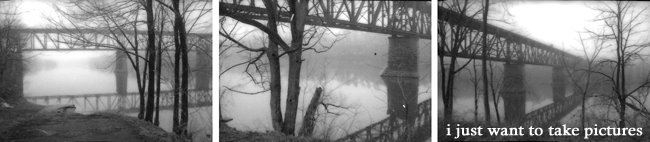
Triptych #2 (train bridge)

Triptych #3 (iron fence)

Thursday, April 30, 2009

The thesis is.... the problem of what this is.


"Why" is the most subversive question. Don’t answer it.


Is the 'construction' of a print, something I want to document/include in the thesis?
Do I include contact sheets in the work? Are they my ‘sketches’ or diagrams?
Do I include copies of historical photographs or just my own?
What is the story I am trying to tell?
What does it have to do with architecture?
Where can I show my work? and can I do it in mid-July?
- Talk to Jeff L. about using one of the empty shops along Main Street.
Write about your obsessions....
What about the town fascinates me?
STARE at my photographs and find inspiration/stories within them
What does pattern recognition have to do with my photos/groups of photos?
- Rhetorical structure of photos
- Tarkovsky
- The group is an immediate lesson in how to see one image “This is the quintessential photograph of this one”
What happens with the individual photos?
What am I getting out of this?

Wednesday, April 22, 2009

hmm...

I am still concerned about the connection to architecture.
Very concerned.

I know it's there - I'm just worried that I may not find it in time,
or that I won't be able to verbalize it.
a.

Today

Triptych #1 (Train bridge)

...from my daybook...

April 21st 2009
I am a bit anxious about reprinting photographs I already did just b/c they're not on glossy. But I want everything to look cohesive and professional so I guess it has to be done.
First up - 3 mailboxes & open/closed. I remember these being somewhat of a pain to print, so I am not too excited about it.

The first issue seems to be the difference in paper - not just pearl vs glossy. Apparently, every batch of paper can be slightly different because of the chemistry used to produce it.

So no the image, which I thought wold take just 15mins or to reproduce is going to take quite a bit longer - I need to iron all the kinks out.

April 22nd 2009
Yesterday did not go well. I printed two images, neither of which I am satisfied 100% with. The open/closed is a train wreck - not less than 3 issues: I messed up on masking, should have exposed the frame longer and this SPOT appeared out of nowhere. It's on the emulsion side of the negative and I can't get rid of it. Bob has a solution I can use to manually touch up the actual print, so we'll see.

I decided to stay away from 're-printing' anything today and I am printing two brand new images - great train bridge pictures taken from underneath the structure.

I have to admit - the only reason I stuck it out yesterday as long as I did is because of this schedule I've made - I can't fall behind, even a bit, if I want to defend on July 16th.

[part way through printing]
Today is going drastically better - the images in the T1 train bridge series were all taken one after another and have the same subject matter so the exposures are very similar. There will need to be adjustments, no doubt, but I may even accomplish 3 prints today.

Because they were taken in foggy conditions, the atmosphere of these images is every different than others I've printed. I am debating on sacrificing increased contrast (and true blacks and whites) to focus on a wide range of greys.
OR, do I sacrifice detail for a feeling of immensity and power??

[after printing]
The images are great. I am not sure what order I will be presenting the triptych, but I managed to print all three components today, which is excellent. I decided to forget about true blacks and focused, instead, on depth. There is a lot of detail within the structure of the bridge, and I thought it was more important to capture that.

Tuesday, April 21, 2009

Schedule

Since I found out I can defend as a part-time student, I started a pretty rigorous printing schedule in order to meet my (self-imposed) thesis deadline.

Main Structure
Thursdays to Mondays - printing days (I worked it out so that every day I print one photo, and about two days a week, I print two - I'm hoping as the weeks go on, this will take me less time each day)
Tuesdays - High resolution scanning/writing days
Wednesdays - Meetings with Don & Photography elective
Everyday - researching/reading/taking photos/developing film

Milestones
May 1
30 photos chosen for printing (I have about 25 chosen already)
13 photos printed

May 25
60 photos chosen for printing
34 photos printed

June 4
Rough draft submitted

June 18
Sign-off
Schedule defense

June 20
Last photo printed (#60)
Last set of high-res scanning

June 21-24
Finish formatting thesis

June 25
Hand in 3 copies to Andri

June 26-28
Officially out of commission

June 29- July 10
Begin work full-time
Mount all 60 photographs

July 11-15
Prepare for defense

July 16
Defend

July 17-19
Officially out of commission

July 20-26
Make suggested corrections to thesis

July 27
Submit to GSO

I think this sounds pretty doable, though I'm not sure if I'm not kidding myself.... what do you guys think? I would also like to have an exhibition somewhere around the defense time, though I am not sure how feasible that is now that I am defending much earlier than September.
a.

Friday, April 17, 2009

Storytelling

When I was interviewed for the program at the University of Waterloo School of Architecture, I was asked the obvious question: Why do I want to study architecture? I barely had to think about it, and I'm not quite sure where the answer came from, but it was what I felt at the time, and believe I would still answer that question similarly if asked today, seven years later.

I said, I wanted to study architecture because I believed "buildings tell stories". Architecture is the result and response of a culture, a history, and a specific time-frame within that history. It tells the story of the architect and all those involved who help shape and design it.

Little did I know, the man asking that question was the school's Iconography professor and the first book he would assign to our incoming first year class would be "the Storyteller".

I have this same reaction to photography, though, now, I would change the wording of my answer. Buildings don't tell us anything, they show us, just like photos. Without captions, a photograph gives you no information - you can't even tell what year or what country it was taken, let alone under what circumstances and what it meant to take that photo or be in the photo itself.

Both architecture and photography are utilitarian practices - architecture provides us with buildings, cities, homes, entire environments to live and work in, while photography documents that life for us, whether to remember, experience or share it. But, at the same time, these two practices enhance our lives and allow us to share with others, what we as a society consider important or worth documenting.

Let's look at architecture for the time being, in the context of my site, Galt, Ontario. The steeples of the town rise higher than anything along the river, creating a beautiful cityscape punctuated with spires. The importance of this was immense at the time of the building of the churches - they were the most important buildings within their Christian community and therefore, nothing could rise above them in hierarchy or in physical form. Recently, it was passed that two new condo towers slated to be built along the river's edge, had permission to, indeed, rise above the church steeples.

Another change within the structure of the town, is the use of existing buildings and the overall use of the town. Dubbed the "Manchester of Canada" in the latter part of the nineteenth century, Galt produced textiles, machine parts and ammunition at a calibre matched by no other town in the country, even her quickly expanding sister-city to the north, Berlin (Kitchener). Her product was shipped to Europe, assisting the British troops during the Crimean War, and even as far as Asia and India. After the industrial revolution & the cessation of passenger train service between Galt and the surrounding areas, the town's buildings slowly began falling into decay.

All is not lost, however, since many of these buildings are now being reinforced and renovated, their old names repainted in crisp, black and white paint on the side, "Tiger Mills" or "The Galt Knife Factory". They have been given new life as condominiums, with 'historical presence and meaning'.

I began photographing this town for different reasons. It made sense practically - I live here and have easy and quick access to my site, and being constantly immersed in the town gives me an insider’s view and perspective. The other reason I began photographing Galt was for the sheer fascination I had with it. The old buildings, the people, the river – it all made for an incredible history, which I read, learned and became very proud of.

I wanted to tell the story of Galt, though for the longest time, was very confused as to what that story was (something I have yet to pin point, though I feel I am getting closer). Was I telling the story of its past and so photographing only the decaying buildings and those which have managed to last all these years? Or was I photographing the story of its future? With the help of the School of Architecture, the Business Improvement Program initiated by the mayor and the whisper of the Venice Biennale making its way across the Atlantic to the small town, Galt was slowly being revived. For the first time in decades, there was a very hopeful future for the town that, in the 70s, disappeared into the large and anonymous collection of other lost towns, known as Cambridge, which in turn was swallowed up by “The Waterloo Region”. The identity, which Galt had worked so hard to achieve and maintain for almost 200 years, disappeared.

I finally settled on simply photographing. I would stop looking for a justification for picture taking, besides my desire to do so, as well, I would stop trying to take an analytical and structured approach to the task of documenting the town. I began to wander streets, not caring particularly where I ended up or how long I was out, as long as I had enough film.

My decision to use 35mm and 120mm film cameras and not digital equipment was automatic. My love of the craft itself drove me to make the decision, though considering the subject is Galt, once a prospering industrial town, it seems very appropriate. It is a manner of production that is based on a meticulous method, utilizing equipment & materials that have not been the primary choice of individuals & industry in decades. This system only succeeds with many man hours, the use of one’s hands (and eyes) and ultimately on skill (which comes only with hours and hours of practice – in the beginning it’s mainly guesswork).

Recently, as the deadline for my thesis approaches, I was directed to begin ‘grouping’ my images. I had attempted such an exercise in a blog entry and it was considered very successful and a good route to take to really identify the patterns in my work. I was pleasantly surprised that photographs, which I had taken months previously, fit in very nicely with those taken just days before – there seems to be a system I am employing, even though I am note aware, yet, of what that system is. As I continued to group the photos, a cohesiveness began to evolve – photos, which I thought were interesting but not anything special, took on a brand new life when placed beside another such, non-descript photo. The power of the pair or group could not be ignored and it is this route that I am taking, attempting to find themes and motifs within my photographs to better understand what story I am trying to tell.

a.

Tuesday, April 14, 2009

In Preparation for Mx Reviews

I've been going through existing photos to see if I could put together more groupings, without actually having to go out and take more photos, just yet. Up until now, I have been somewhat worried that most of the photos I had taken were completely useless. I was concerned that I had not even taken a quarter of the required (good) photos for the thesis, but it seems that I might be well on my way... I hope, anyway. Here are some more.... (some photos appear more than once).

a.


WALLS


...somewhat phallic...

Groups of four.

River bank walls.

Fences.

The back of the Ainslie street block.

Monday, April 13, 2009

Groupings

In preparation for the Mx Reviews this coming Thursday, I am preparing some more 'groupings'. I am hoping this exercise helps me look at my existing photographs in a different light, and possibly be an inspiration for more photographs, either to go into current groups or to add variety. I have noticed I have quite a few train bridge shots, three groups, actually, so I think that topic is sufficiently covered for the time being.

I don't think I can have all of these developed in time for the review, in fact, I'm not sure I want to, so I am going to see about developing as much as I can, preparing my presentation and bringing in a projector to show my work. I'd like to get opinions before developing all these photos, not knowing if they will be included in my final selection.

Please ignore the quality variation in some of these groups - some are scanned prints and others only scanned contact sheets. Also, if you notice, some of the groups contain recent photographs as well as ones taken many months ago. I think this is a good sign that, perhaps, some of the pieces is starting to come together into a coherent work.

a.

The train bridge.

This grouping previously included a different photograph. This new photograph is a scan of a final 7"x9" print and I think it is much more successful. I am very happy with this picture.


She is sad and beautiful and I'd steal her if she wasn't chained to the post. But that's probably what makes her so beautiful.

I saw a similarity in composition between these two photographs, though the difference in light might be too much of a distraction... maybe I need a third.

A new addition (of an old photo) to a previous twosome.

Some new, some old photos... backyards.

A large house up on the hill.

Collections.


Here are two of the newest contact sheets & some images from them which were not included in the groupings.


This one was really just for me.