Showing posts with label Intro. Show all posts

Saturday, June 27, 2009

Intro... round two.

Although.. the more I read it, the less I am sure about it.

There is a seduction in the combination of two passions to create something new; synthesize the originals. The experience inevitably becomes a third passion or, sometimes, even an obsession.
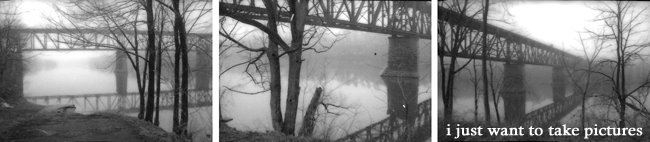
In the winter of 2008, I thought, ‘I just want to take pictures,’ convinced that there must be a way to relate photographs to architecture, or architecture to photographs. Caught up in the dialogue of what is architecture and what is art, I spent almost an entire year trying to justify why I wanted to take pictures, what it had to do with architecture and what it all meant to me.

I familiarized myself with photographers - incredible photographers - like Walker Evans, Harry Callahan, Eugene Atget and Robert Frank. After all, the more photographs we see, the better photographers we become. I read texts by Susan Sontag, Roland Barthes, Walter Benjamin, John Szarkowski and Stephen Shore, hoping they had the answers I was looking for.

I decided to photograph – to throw myself into the act of taking pictures. I stopped looking for a justification for it, besides my desire to do so. I wandered through Galt, taking pictures when something caught my eye, and, though not structured or pre-meditated, this wander became my format.

When I finally decided to photograph, through the experience of it, I located my thesis and made a relationship to architecture.

Tuesday, June 16, 2009

Preface

So it was brought to my attention that the "Introduction" I had written is actually a preface. So here it is, again, re-written and drastically shorter.
a.

In the winter of 2008, I thought, “I just want to take pictures,” convinced that there must be a way to relate photographs to architecture, or architecture to photographs. Caught up in the dialogue of what is architecture and what is art, I spent almost an entire year trying to justify why I wanted to take pictures, what it had to do with architecture and what it all meant to me.

I began familiarizing myself with photographers - incredible photographers - like Walker Evans, Harry Callahan, Eugene Atget and Robert Frank. After all, the more photographs we see, the better photographers we become. I read texts by Susan Sontag, Roland Barthes, Walter Benjamin, John Szarkowski and Stephen Shore, hoping they had the answers I was looking for.

I eventually decided to photograph – to throw myself into the act of taking pictures. I stopped looking for a justification for it, besides my desire to do so. I wandered through Galt, taking pictures when something caught my eye, and, though not structured or pre-meditated, this wander became my format, my modus operandi.

There is a seduction in the opportunity to combine two passions and create something. Synthesizing the original two, the experience inevitably becomes a third passion or, even, an obsession. When I finally decided to photograph, it was through the experience of it, that I located my thesis and its relationship to architecture.

Wednesday, June 10, 2009

Intro... maybe.

One of the reasons I chose to complete my Masters of Architecture at the University of Waterloo was because of the incredible freedom the curriculum offered. Architecture's potential field of study is massive. I was seduced by the idea that I could take something I was passionate about and create a thesis.
I began my first term in January of 2008 thinking “I just want to take pictures,” convinced that there must be a way to relate photographs to architecture, or architecture to photographs. I spent almost an entire year trying to justify why I was taking pictures, what it had to do with architecture and what it all meant to me. There was no spark. I had tried to make the connection between photography and architecture via theory, and it all came to naught. After a very confusing couple of terms trying to figure out what Barthes could have possibly meant by “cameras are clocks for seeing” and how photography is related to time and death, I found myself, once again thinking, “I just want to take pictures”.
I finally settled on doing simply that: photographing. I would stop looking for a justification for picture taking, besides my desire to do so. I would stop trying to take an analytical and structured approach to the task of documenting the town. I began to wander streets; if something caught my I would photograph it. I did not care particularly where I ended up or how long I was out, as long as I had enough film. And, though not structured or pre-meditated, this wander became my format.

I soon discovered that it was that freedom to create, which I had been so excited about, that was actually what had crippled my progress. I felt I needed a reason for that creation – a justification. I began familiarizing myself with photographers - incredible photographers - like Walker Evans, Harry Callahan, Eugene Atget and Robert Frank. I read texts by Susan Sontag, Roland Barthes, Walter Benjamin, John Szarkowski and Stephen Shore, tapping into the minds of brilliant writers, hoping they had the answers I was looking for.
This determined search for a thesis only confused and disoriented me more.
I went through iterations of my abstract, week after week, and each time it seemed I was doing a different thesis. Nothing seemed to work, because I was doing things backwards. I would look for a suitable architecture thesis and only after that, would I attempt to incorporate photography. Since it hadn’t worked, I began to question if photography as a medium or topic had been the right choice.
When I finally decided to photograph, it would be through the experience of it, that I would locate my thesis and its relationship to architecture.