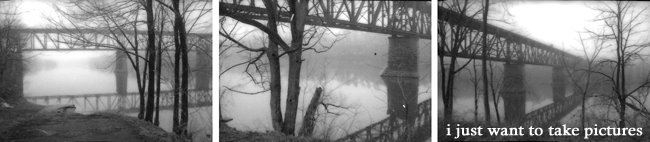
Tuesday, March 31, 2009

...from my daybook...


March 4
Left the house around 1pm and walked around North end of Galt for the first time (Wellington, Kerr, Beverly, etc.). Focused on residential details - yards, porches, sheds) using 35mm Pentax. (Result: Third contact sheet in this post).

I'd like to go at dawn and dusk for the next shoots to get different light.

Photographed Royal Hotel wall w/ 120mm Mamiya for second mini-project. "We have a tendency to photograph things on their way out," (G. Sorbara).

The renovations on the bldg have begun - walls are being cleaned, repaired, torn down. here were incredible textures, patterns and compositions. The series was quite successful - developing negs tomorrow.

March 5
The negatives are a bit underexposed - must have stopped won from what the 35mm light meter indicated. Thought that because it was really sunny there was a chance of over exposure...not the case.
The image of the school yard taken from balcony turned out well - great contrast.

March 10
Went home (Niagara) for the weekend - forgot the Mamiya and colour film. I had wanted to take pictures of Stella Street and family.
Developing photos - not so easy.
Using a new enlarger (for the 120mm negs) is proving a bit of a set back.

Wall enlargements are coming out grey - I'm having trouble getting true blacks and whites. Slightly discouraged - hoping to be able to enlarge photos to show the texture qualities I intended to capture.

[after enlarging]

No.5 filter seems to be getting me whites and blacks in wall images.
Great school enlargement.

[evening]

Finished shooting roll w/ Pentax - it was great atmosphere. Just after rain and sunset, misty, glowing. Had issues w/ the light meter so the photos might not turn out. Should try own Pentax MZ7.

March 11
Meeting with Don today.
He compared photography to wind - the difficulty of capturing the energy, but not the by-product.

March 14
I discovered shadows today in the image of the porch - it'll add incredible depth and interest to the image. The discovery is thanks to the advice of Bob for always saying it is better to expose the paper for too long rather than not long enough.

.... some notes on exposure follow...

Three seems to be my maximum for the day. I need to catch up so I can begin producing only one final enlargement per day - I seem to have a lot of patience and enthusiasm for the first enlargement.

March 16
Spoke with Bob.

Re: Porch
He likes the first exposure better - says windows provide a feeling of entering into photo and traveling upstairs. He says the couch, when not burned, looks more inviting - like he cold go and sit down on the it and bask in the sun.
Detail in wood beam is great.
Shadow of porch could be slightly lighter: 4-5 sec.

Re: Factory
In contrast to the original 4x6, the 7x9 photos both feel truncated. Suggested to take photo to 9-1/2 wide and make vertical whatever it happens to be (probably around 6).
What he really likes: angle of tree, rise and dip of snow (partially lost in truncated version) and balance of light on right and left sides (also partially lost in truncated version).
Suggested 10sec or less on snow and to burn the right side only, 15sec or so?

Re: Trains
Good contrast. Snow in background does not really bother him as much as it should. Suggested slightly less on actual trains (highlights of snow on roof are almost lost), plus 4-5 sec dodge on wheels. Snow in front could be a couple sec. darker.

[after developing]

"You are to be congratulated" - Bob
Two finals are successfully enlarged! It feels really good to know two photographs have been 'figured out', so to speak.

March 19
Attempting third final - the pace needs to quicken drastically. I want (need) ten finals for next wednesday.

...some notes on enlarging follow...

I have been watching BBC Documentary "The Genius of Photography". Hilla Becher spoke about photography on grey, clear days - they allow you to see much more than sunday days which cause shadows.

So, I went out yesterday and shot a roll of film (Wellington, Walnut, to Ainslie townhouses and around neighbourood South of Concession). It was a monotonous grey light so we'll see how it turns out. (Result - first two contact sheets in this post).

I've decided to pay part time tuition next term, but not work part time. Will start full time work in July after thesis is done. I am giving myself until the end of June to submit.

Final #3 (Trains) may be done - might require changes after I speak to Bob.

...from my notes...

During the  last meeting...

What tense to write in?
What perspective to write from?

When do you make transitions?
- when you lose the train of thought
- no explanation needed for making transition

"Good writing is the mastery of digression," (Don).

Wednesday, March 25, 2009

That somewhat sketchy place called the darkroom....

Speaking to a friend this past weekend, I realized that most people have no idea what actually goes on in the darkroom. Why does it take so long? Why don't I just send my negatives away to get developed? What's all this about? I wrote a previous post about the composition of a photograph... testing each piece for exposure, dodging and burning (they're not just Photoshop techniques, people) but I decided that maybe showing exactly how a final image comes together is the best way to demonstrate the process.

As noted today in our meeting that if I wrote down exactly what it took me two minutes to say, I'd have 1000 words to throw into my thesis, verbatim. But to use my favourite adage, a picture is worth a thousand word and so here are 9000 words or so worth of explanation.

words to know
burn - to expose an area to light while blocking out the rest of the image
dodge - to block one small area of image while exposing the rest to light


first enlargement notes for image below
  • f8, filter #1, 35 sec., 10 sec. burn bottom portion (below porch shadow)
  • bricks above porch roof too light
  • slightly too dark under porch roof, especially above door
  • lacking information in door
  • left side near sofa - too light?
  • snow washed out... needs more time

bottom (snow)
f8
, filter #1
60 seconds.... slight too dark? does snow look grey? 55sec will work better.
top (bricks/windows)
f8,
filter #1
60 sec. (perfect)

couch
f8, filter #1
60 seconds
good detail, but Bob points out, looks cold... lost sunny and warm feeling
shadow & door
f8, filter #1
30 sec. entire picture
+10 sec. burn, lower portion below porch shadow (shadow still too dark)
+10 second burn on door and snow on ground (snow slightly too light now, door still definitely too washed out)
shadow
f8, filter #1
25 sec. entire picture
+5 sec. dodge of shadow (sort of missed the darkest part I wanted to test... try again)
shadow
f8, filter #1
23 sec. entire picture
+7 sec. dodge of shadow - good amount of detail. area above door is not brick, something else - will have to remain dark, I think that will be okay in the composition
door
f8, filter #1
60 sec. - MORE. not enough information
door
f8, filter #1
90 sec. - shadows! could be slightly lighter - but great detail.
door, shadow and snow

f8, filter #1
30 seconds entire image
+10 second burn below porch
+15 seconds on snow (great!)
+50 second on door (almost... looks a bit dirty, so perhaps lighter by 10 sec.)

final
f8, filter #1
30 sec. total during which....
  • 13 sec. entire image
  • 7 sec. dodge porch shadow (left side of post)
  • 7 sec. dodge porch shadow (right side of post)
  • 3 sec. dodge snow on roof to whiten slightly
then...
10 sec. burn entire lower portion below porch shadow
20 sec. burn top portion (brick and windows)
15 sec. burn snow
40 sec. burn door.

ta-da!

soundtrack | ten songs

part one
songs that have something to do with my thesis (as related to time, observation and truth)

black and white town by the doves
fake tales of san francisco by arctic monkeys
i believe in symmetry by bright eyes
the fly by u2
time by pink floyd

part two
songs that help me get through my thesis - because you can't cry when you're dancing!

bruises by chairlift
not fair by lily allen
big girl (you are beautiful) by mika
you're gonna go far, kid by the offspring
so what by pink

Tuesday, March 24, 2009

Formulating an Abstract + some Advice

Questions to help formulate an abstract:
  • What am I doing?
  • Why am I doing it?
  • How am I doing it?
  • What do I hope to find?
  • What will the significance be?
What am I doing?
I am taking pictures of Galt.
The object of study can be the subject of study - architecture.

Why am I doing it?
I wish "Why not?" could count as an answer....
I am doing it because I want to take beautiful photographs. I want to explore the city and document it, find places that are poignant, unexpected (or expected), have something to say, or sit quietly in the background. I want to record history. There are a lot of "I want"s in this paragraph.. the simple answer really is, "Because I want to."

How am I doing it?
I am using a 35mm Pentax and a 120mm Mamiya, black and white film (100 speed) and developing the images in the darkroom myself. I wander around the town, trying to explore different areas and document them. I return to places I believe have character that perhaps I haven't been able to capture yet or places I would like to visit in various lighting conditions. There is no set way in how I explore the town. It's a bit of a meandering wander - I end up where I end up.

*In the last couple days as I have been posting negatives and other images on this blog, I have realized just how much time I have been, am now and will be devoting the actual enlargement of these negatives in the darkroom. Having gone through about 30 photographs in a matter of hours, touched up quickly, fixed scratches - it really made me look hard as to why I have decided to physically and manually (and painstakingly) develop my images. For now, my answer is - for the craft. It really is about the priviledge of being so closely involved with the images - of spending hours in a dark room perfecting each corner of a photo until it all comes together to form the final print.

What do I hope to find?
I'm not sure if there is anything in particular that I am looking for. I think the idea is more about bringing together a cohesive image or depiction of the town - by seeing photo after photo, I hope to take viewers on a walk through the town, follow in my footsteps and see (through my eyes) what I have seen.

What will the significance be?
This is the question I am having the most trouble with. In the grand scheme of things, this is not a redesign for the better of a city core.... or research into social housing and making the lives of people better. It is art for art's sake, as well as, being about the town. It is about presenting Galt to a greater audience and in a different light than perhaps it has been perceived in the past (see the last quote at the bottom of the post).

Advice
At my Mx reviews last fall, there were a couple quotes by the professors, during my crit and the one previous to it, which I wrote down. I can't remember who it was that said what, but some I remembered, so I credited.

About progress...
"become OBSESSED" Geoff
"Don't be good. Everything/everyone is a subject" Don to me
"Project the project forward - don't be meek. 'Here's my MASSIVE idea'"

About the outcome...
"What do I want the result to look like?" (work backwords)
"Who's work do you most wish your work could be like?"
"Which project do you most desire yours looked like right now?"
"This isn't your last project, it's your first project." Geoff

About titles...
"'Adaptive reuse' is a healthy meal. 'Wallowing in shit' is a feast!'" (Don)
"Think of a name you could put in italics"

My favourite quote was from Geoff, and it really hit home in terms of what I want to achieve:
"Tell the town what it has not seen of itself."

Monday, March 23, 2009

Why Photography?

The last couple weeks, I have sat down several times to write what I was thinking, try and explain to myself why I am doing what I'm doing. The format is very informal, as I was basically talking to myself and recording the conversation.

Why take photos of Galt?
I wanted to take photographs of Galt because of the incredible history in this town. In such a short period, it's gone from being dubbed "the Manchester of Canada" to presently being swallowed up by the City of Cambridge, not to mention the Region of Waterloo. It is mainly bypassed and driven through. Most of the old buildings have stood their time having only changed tenants - many of them are falling apart and are in serious need of repair. The CIBC building is an exception, having been the first tenant in the building at the corner of water and main and remaining there today (after an interior renovation in the 60's).

I feel there is a change coming to the town and, though slowly, it's on its way back up again. The demise of the Royal Hotel and its current rebuilding gives me that idea. There is something to be said for someone who invests so much money in a building that would have been much cheaper to simply tear down. There is history here. And, though, selling crack through a hole in the wall in the bathroom may not be anything to brag about, it is part of the texture that makes up the history of this town, and helps define the town as it stands.

Why do I want to take photos?
The first reaction that comes to mind is that I don't just want to take any photos, I want to take beautiful photos. I want to find the beauty that lies in this town, some of it obvious and some of it not. And though one begs to question whether something is beautiful because it is photographed or whether it is photographed because it is beautiful, I am not sure I am ready to answer that question in this thesis or whether or not it is my responsibility to do so. Light, shadow, texture and form do an amazing job to create beauty in places where it may not be typically present.

I almost feel that taking photos of ruins, and abandoned buildings is a somewhat cliché, an image I don't want to be tied to. But, on the other hand, there is incredible beauty in things that have been abandoned, worn down by weather, changing and existing on their own.

There are those other things, like cheap subdivisions and condos, buildings built and created solely to cash in on a portion of the money that has somehow been slowly coming back to the town since the school moved in. And though, I don't find those buildings beautiful, I do find the images of them moving, or telling. They also make up a part of this town, its present history, and since I do not believe they are a good idea, lack character, quality and all the things that make good architecture, I believe juxtaposing them with the defiant structures of the original town, gives them an incredibly weak, almost laughable, image.

The houses in the various areas around the downtown core amuse me. There are the mansions in West Galt - beautiful old buildings, full of character and amazing workmanship. Some, though, are still ridiculously monumental for the sole purpose of being a residence to a single family. On the east side of Galt is another hill - old houses again, not nearly as monumental, still filled with character - though many of them more so from their owners and tenants rather than their architectural appeal.

The 1950's neighbourhood to the South of Concession Street is almost surreal. Though I am used to seeing townhouses and condos, all lined up like ducks in a row, not knowing one from the next, the small 900 square foot symmetrical boxes line the streets so identically, it becomes somewhat rhythmic and soothing.

In between all these distinct classes are a mish-mash of beautiful houses amid incredible trash - homes with terrible proportions, vinyl siding galore, and of course, 'furnished' porches and kitsch strewn yards.

Sometimes, depending on the light, incredible shapes, forms, textures and scenes emerge from these random places, weaving together the characters that make up the town.

Where are all the people?
I have never had any inclination to take pictures of individuals – people are too unpredictable, and I enjoy the patience I can employ while waiting for the light right, trying the image from a different angle. Also with all the red tape involved with taking photographs of people, I rather stay away from the whole thing. I have become much more brave at approaching people’s homes, backyards and properties in general to photograph them, but photographing people is still beyond my realm of courage. (Unless I do it the Walker Evans way and release my photos ten years later in fear of being sued). There is a certain amount of control which must be relinquished when photographing people.

There is constancy in buildings – something to always expect, and yet something to always be surprised by. Though I may see a building a hundred times, passing it on the street daily, there can be one instance in which, it shows itself in a different light (pun intended), and everything about it changes. It is my responsibility (and privilege) to experience and capture that exact moment, if I am prepared and capable.

What does it mean to take a photograph?
Being a photographer, I immediately believe that the photograph belongs to the person who captured it with his or her camera. There is no doubt in my mind that buildings, once built, are in the public domain. They are in the street, they are viewed every day, there is no reason why someone, for whatever reason, cannot take a photograph. Wallpaper, clothing – anything that is designed, at one point ‘belongs’ to the designer, but after it is released for others to purchase, to see, to interact with – the designer relinquishes his or her control. Arguably, someone inevitably owns the building and the actual property on which it sits, and so they can control photography taken inside. Unless there is some sort of security threat, they, I do not believe, have the right to control the taking of photographs.

Though I tend to think the same when photographing a person, I am sure I would be of a different opinion if the photo in question were of me. In an intimate setting, yes I think there is an issue of privacy, defamation is possible and many other issues. But out in the public domain, with the mass production of cameras and camera phones, one cannot expect to never end up in a strangers photo. And though entering the frame could be completely accidental, or staged and patiently expected by the photographer, neither, I believe, should be an issue. There is the, obviously, the problem of people who are ill and take photos for personal use and abuse, but this, I think, begins a more political discussion. You can’t control a person like that, but you can control your own actions. I have had my photo taken randomly by a camera phone on a bus, and found it incredibly creepy – but I simply moved away from the person and out of their view.

The reason for many tribes in North African (?) countries and elsewhere to fear photography is pretty simple and really quite understandable. Their belief system explains our souls, our essential being, as having a multitude of layers. When a photograph is taken, one of those layers is trapped within the photograph to create that image and so the subject is one layer closer to ceasing to exist. This belief is actually very close to what Sontag and Barthes spoke of when they referred to the light emanating off a photograph. The exact light that took the photograph of a missing person was absorbed by the camera, which then recorded that photo. That light produced that photo and now allowed Barthes and Sontag to see the image of that person, linking them physically to the person through light.

Composition
What many people are not aware of is the incredible work that occurs in the dark room after the photo is taken. I completed two final prints today – my first two out of approximately sixty to come. And, for the first print, there must be at least twenty scrap test sheets – puzzle pieces that make up the complex areas of the photo, those that have to be tested and retested, burned or dodged. Within every photo that is printed, each area of shadow or light has to be tested, compared, altered – discovered. To make the final composition work, look as coherent and beautiful as it possibly can, many different components have to be finalized first.

I had an incredible day when I was working on my first print – still messing around with shadows and trying to find information in areas of light. I decided, upon the advice of my mentor, to risk it – to risk exposing the light area too much, rather than not enough. If I had decided to only expose it a little bit longer than I had already done, hoping there would be more information, I would never know what information could possibly be lying in the image if I exposed to, say, twice the amount of time as I had previously done. And, amazingly enough, I discovered shadows where previously I thought there were none! It seems quite ridiculous, but it was an incredible find as it brought that portion of the image alive – dancing tree branches on an old and rusty front door – one more piece of the puzzle was complete.

There is a very obvious connection with design in this entire process – once in the darkroom the composition of the photograph becomes a design of components. You must first perfect each component, but, all the while, keeping in mind how it will compare with the rest of the image. You may discover that an area seems too light, missing information, looking slightly under exposed. But, after having exposed that small piece of the picture longer, you find that the whole image now seems colder, less inviting. You discover that, even though on its own the small area seemed much too bright, in the whole of the picture it actually provided a ray of sunlight, of warmth – a destination for the viewer, where he or she could image themselves sitting on a tattered sofa on a porch, basking in the afternoon sun. By taking away that warmth, you change the atmosphere of the photograph and its connection to the viewer.

I have learned to underexpose the shadows and over expose the light – information lurks in areas you would not expect and though our eyes are complex enough to be able to pick out these tonal changes and hidden information, the camera lenses are not capable to see what we see. It is our job to then find what the camera cannot see – or does not know it sees.

Why Photography?

From M3...

tex·ture [teks-cher]
noun, verb, -tured, -tur·ing.

–noun
1. the visual and especially tactile quality of a surface: rough texture.
2. an essential or characteristic quality; essence.
3. the quality given, as to a musical or literary work, by the combination or interrelation of parts or elements.

In photography, texture plays a vital role to the quality and composition of the image, just as pattern, light and tone do. And though it is obvious as to how photography helps capture the physical texture of materials, it may be less obvious as to how it captures texture as history.

I chose photography because of the inherent characteristic of a photograph as an index, a trace of the past. It is proof to the existence of something. Photography I believe is appropriate when studying the history of Galt, from its inception until the present time. The photograph allows me to capture solitary instants within the flux of time that when brought together provide the viewer with an aspect of time.

Quotes

I have had these quotes written down since the beginning of M3 and they still ring true to my opinion of photography, its benefits, limits and relationships to architecture. The explanations of the quotes are not very eloquent - they were just a way for me try to explain (to myself) what it was the quotes meant to me.
a.

on photography as event

“Even so, photography offers the possibility to freeze aspects of reality of architecture and light that might vanish when contemplated in the flesh. It is also true that through photographs fiction is greater, although reality might be more surprising.”
- Elias Torres

"Although the event is always something that takes place in a global disorder devoid of meaning, this happy moment - at times accidental, at times the result of a willing intellect - constitutes an outstanding instant in a constant flux, a harmonious, polyphonic chord in a situation of permanent transition.”
- Ignasi de Sola-Morales

Though Sola-Morales is referring to an event and the architecture of an event, I find that this quote defines photography very accurately and, in a way, echos the idea behind Torres' quote. After all, a photograph is just a happy moment captured from a stream of constant flux and chaos. That instant is then transferred to a place of permanent transition where the instant will exist forever and never change.

on photography as trace/evidence

"As distinct from symbols, indexes establish their meaning along the axis of a physical relationship to their referents. They are the marks or traces of a particular cause, and that cause is the thing to which they refer, the object they signify."
- Rosalind E. Krauss

The photograph is an index or referent of what existed at the moment that the photograph was taken. It is a footprint or trace left by the photographed object, event or person. Just because a photograph is an accurate trace, however, does not make it true. As Barthes says previously, it is simply proof that something existed.

on the limits of photography
“The decline of narrative painting in the past century has been ascribed in large part to the rise of photography, which “relieved” the painter of the necessity of story telling. This is curious, since photography has never been successful at narrative. It has in fact seldom attempted it… The heroic documentation of the American Civil War by the Brady group, and the incomparably larger photographic record of the Second World War, have this in common: neither explained, without extensive captioning, what was happening. The function of these pictures was not to make the story clear, it was to make it real.”
- John Szarkowski

A photograph without words or captions does not tell a story; it is only a glimpse into a moment, and without captions the explanation of that moment is not any clearer to us once we have seen the image. The photograph is only evidence that the moment occurred.

Recent Questions

In the last meeting these were some questions that were asked me. I'm still working on the answers to them.
  • What does it mean to take a photo?
  • Who am I taking it from?
  • Why can't I just take a picture?
  • Why this instant? Why press the shutter just then?
  • Why do I want to take photos?
a.

Negatives


About a month back or so I went to visit my sister in Toronto and took advantage of the OCAD digital lab to scan some negatives. I have adjusted the contrast on most of them, to give them a bit of pop... I don't think you'll have seen any of these in my other posts.

Though I've corrected some of the horizontals, there will, unavoidably be quite a few that look quite wonky (I apparently have issues taking straight photographs). And though I did take some time correcting contrast and scratches, I didn't want to spend too much time on something that, ultimately, doesn't help too much towards producing the actual thesis. I have also (regrettably) discovered what my stubborness for developing my own photos means.... hours and hours in the dark instead of a fraction of the time on a computer.

I also apologize for the barrage of photographs you've been exposed to in the last couple days. After this, I promise I'll be posting some more text. Some of these photos are pretty crap - just a heads up.

a.


Cameras are Clocks for Seeing


date | 16.02.09
chapter context

Barthes discusses what it is, as humans, we do when we know a photo is about to be taken. We transform ourselves into what we would like the image to look like – in essence, we transform our selves into the image in advance. But, when the photo is taken there is a moment of uncertain filiation – what type of image will be ‘born’.

Even though one consciously poses for a photo it is important to differentiate between the essence of the person and his effigy – he is more than his image.

In the past, there was a fascination with the mysticism of the vision of the double, often hallucinations (maybe due to schizophrenia, epilepsy). The action of taking a photo means that anyone can see a vision of themselves (unlike in a mirror). Barthes is concerned that no one has thought of this disturbance to civilization. He says that “photography is the advent of myself as other: a cunning disassociation of consciousness from identity,” (Barthes, 12). It is when our identity and our essence can be separated and considered each on its own. One still does get the feeling of the mythic theme of seeing a double, when one looks at him/herself on a piece of paper, as an object.

Because photography transforms a subject into an object, once on that piece of paper, who does the photograph belong to?

Barthes explains there are four image-repertoires that intersect when he is sitting in front of the lens. They are the one I think I am, the one I want others to think I am, the one the photographer thinks I am and the one he makes use of to exhibit his art.

There is a constant self-imitation when taking a photograph and because of this, when photographed, one suffers from the sensation of inauthenticity, or imposture.

That moment when the photograph is taken, one is neither a subject nor an object, but a subject who feels oneself becoming an object- a micro-version of death (when a person dies, they become an object – and the same occurs when a photograph is taken of them). When we look at a photograph taken of us, (the product of this operation) we see what has become of us – Total Image or Death in a person. We experience ourselves as an object. That object can now be filed, used, stored by the photographer – returning to the question (who does the photograph belong to?).

When Barthes looks at a photograph of himself, he looks for Death because he believes it is the eidos of that photograph. The only thing he enjoys (or tolerates) about having his photo taken is the sound of the camera. The organ of the photographer (the finger not the eye) is such because it is linked to the trigger of the lens and to the metallic shifting of the plates. That metallic click breaks through what he describes as the mortiferous (deadly) layer of the pose.

“For me the noise of Time is not sad: I love bells, clocks, watches - and I recall that at first photographic implements were related to techniques of cabinetmaking and the machinery of precision: cameras, in short, were clocks for seeing, and perhaps in me someone very old still hears in the photographic mechanism the living sound of the wood,” (Barthes, 15).

Previous Abstract


date | 13.02.09
working title | the texture of a town

Texture – more than just the tactile characteristic of a surface – refers to the multitude of facets contained within any one place, whether it is a single street or an entire city. The threads of history – success, tragedy, progress, development, industry – intertwine to create a story that solely and inherently belongs to that particular site. This texture of a place refers to “the quality given, as to a musical or literary work, by the combination or interrelation of parts or elements,” or more simply put, its essence.

Within the framework of the photograph, texture as tactile quality and texture as essence are unified. Through a historical, as well as, photographic investigation of the town and its history, this thesis attempts to tell the story of Galt, Ontario – from exponential growth and success, through neglect and decay to recovery.

This paragraph will be a quick description of the town’s history, starting from its beginnings almost 200 years ago, through impressive growth, producing top-quality materials for the war effort, textiles and machine parts continuing through to the implementation and success of the steam and electric rail.

Then it will mention post-war Galt and the closing of the rail system. It will finish with mention of the amalgamation with Preston and Hespeler in 1973 to create Cambridge, the official cessation of the existence of Galt.

A quick mention of improvement projects and businesses/ cultural institutions that have invested money in the area recently, such as the School of Architecture, Biennale etc.

The photographs contained within this work are not intended to pass judgment, but rather, to act as accompanying material in the narrative of how a mid-sized city in southwestern Ontario came to be.

“The photograph does not call up the past
(nothing Proustian in a photograph).
The effect it produces upon me is not to restore what has been abolished
(by time, by distance) but to attest that what I see has indeed existed.”

- Roland Barthes

Comments

I've opened up the allowance for comments to anyone, even if you don't have a Gmail account or other form of accepted ID. Because of that, though, I will be moderating the comments - I usually accept it within a couple hours of the post, but please be patient with me if I'm taking a little longer.

a.

Sunday, March 22, 2009

Contact Sheets

Contact sheets! Because I have not even scratched the surface of enlarging all the photos I've taken, I thought I'd upload some of the more recent contact sheets I've made. There are a couple photos within them that might work... I'm not convinced by the majority of them though.

There are a couple contact sheets from quite a few months back, but I haven't really enlarged any of the photos off them, so I thought I'd include them in this post. The contacts sheets begin at the most recent.

I also isolated some photos that I might consider enlarging to see how they look. The file size of each contact sheet is about 5megs - so it might take a while to open the file. I kept them that size to allow for more convenient viewing of the photographs - otherwise they would have ended up incredibly small.

Note that order or size does not indicate any sort of hierarchy or preference.
Oh and don't mind the pen and marker scribbles all over the images.


I clearly have something with this school, maybe it's because it's all I see out of half the windows in my house.... this photo, though, is taken four floors up - I like this perspective.
I like how these look together.

I like the scale of this.

Left: I was trying to get the striations on the ground...
and I like the fishbowl look of the scene.
Right: I actually like the feeling the non-vertical lines provide in the image.

Southworks Antique Market - I think there is potential here.

Sort of plain, but I like the composition.

I don't think I managed to do what I wanted... the shapes of this shrubbery looked pretty interesting, but I'm not sure it works as a photograph.


Some photos around the bus station. Bottom right - I liked how the lamps were positioned to offset the steeples... I might have to try this one again. Bottom left: I like the gloss of the fresh coat of paint.

The house reminds me of cyclops without an eye.
I know, makes very little sense.
This is the second picture I have of the drawings in these windows (here is the other). There is something about them, but I'm having trouble capturing whatever it is I like about them.
Okay, this makes me laugh every time. I've known about the proximity of the townhouses to the warehouse, but I'd never seen it from this view. Incredible. I'd like to capture it from the other side as well.


Top two: the other side of the row houses on Harris.
Bottom left: the side and back of the Royal

Sneaking around peoples' backyards, front yards and driveways.
The quality looks like that of a photo taken a hundred years ago, but it's just b/c I had to lighten it up from the contact sheet quite a bit. It's the only night shot I have so far, but I think there is something here - I especially like the four lit windows (note to self: more night, dawn and dusk shots).


More houses.


These are different than any other photographs I have... so I'm not sure if they go or not. There is something very bizarre about them.. especially the top right. The bottom two might be too picturesqe or landscapey for this thesis.

I KEEP telling myself that I'm going to take more dusk, dawn and night shots and I have yet to do that. I did try to take some night shots and learned that my light meter goes a bit nutty when it's too dark, so I'll get a handheld.

a.