Sunday, June 28, 2009

Regarding the last post...

Don's advice:

"Don’t try and spot the core of the thesis.
If you want a working thesis: We use photography as a stand-in for
architecture; we are tourists in photography.
Best thing to do is save the quote, so you can reflect on it, and keep
working on the body of the thesis, in blocks."

Quote saved for reflection, working on body of thesis.
Got it.
a.

Saturday, June 27, 2009

Some ideas I am having trouble with...

“Thus not only does our access to the experience of places necessarily pass through the media that make them accessible to us, this mediation is architecture itself. In other words, it is not only the necessity of mediation but also the mediatic condition, the establishing of fictions, that is intrinsic to architecture and the urban landscape.”
Ignasi de Sola-Morales
Mediations in Architecture and in the Urban Landscape

The bolded line is essentially my thesis. But how do I explain that the mediation - the photograph, the written work regarding architecture is architecture itself..... ??? Or is that what I should be saying? It's so hard to try and sum up what the entire work is on through one such profound statement.

Helen Liggett sort of answers this in Urban Encounters, but I am still not sure if I understand it enough to explain in my own words.

“Both making and viewing images make new space… Viewing the photographic images becomes a mode with which to encounter the urban, not as a static environment, but as a boarding house with certain vacancies where temporal experience need only apply.”
Helen Liggett
Urban Encounters, 1993.

I am also trying to address 'the establishing of fictions' being intrinsic to architecture... fiction comes up again in a quote by Elias Torres:
"It is also true that through photographs fiction is greater, although reality might be more surprising.”

Those are two of my main issues right now.
a.

Intro... round two.

Although.. the more I read it, the less I am sure about it.

There is a seduction in the combination of two passions to create something new; synthesize the originals. The experience inevitably becomes a third passion or, sometimes, even an obsession.
In the winter of 2008, I thought, ‘I just want to take pictures,’ convinced that there must be a way to relate photographs to architecture, or architecture to photographs. Caught up in the dialogue of what is architecture and what is art, I spent almost an entire year trying to justify why I wanted to take pictures, what it had to do with architecture and what it all meant to me.

I familiarized myself with photographers - incredible photographers - like Walker Evans, Harry Callahan, Eugene Atget and Robert Frank. After all, the more photographs we see, the better photographers we become. I read texts by Susan Sontag, Roland Barthes, Walter Benjamin, John Szarkowski and Stephen Shore, hoping they had the answers I was looking for.

I decided to photograph – to throw myself into the act of taking pictures. I stopped looking for a justification for it, besides my desire to do so. I wandered through Galt, taking pictures when something caught my eye, and, though not structured or pre-meditated, this wander became my format.

When I finally decided to photograph, through the experience of it, I located my thesis and made a relationship to architecture.

Tuesday, June 16, 2009

Preface

So it was brought to my attention that the "Introduction" I had written is actually a preface. So here it is, again, re-written and drastically shorter.
a.

In the winter of 2008, I thought, “I just want to take pictures,” convinced that there must be a way to relate photographs to architecture, or architecture to photographs. Caught up in the dialogue of what is architecture and what is art, I spent almost an entire year trying to justify why I wanted to take pictures, what it had to do with architecture and what it all meant to me.

I began familiarizing myself with photographers - incredible photographers - like Walker Evans, Harry Callahan, Eugene Atget and Robert Frank. After all, the more photographs we see, the better photographers we become. I read texts by Susan Sontag, Roland Barthes, Walter Benjamin, John Szarkowski and Stephen Shore, hoping they had the answers I was looking for.

I eventually decided to photograph – to throw myself into the act of taking pictures. I stopped looking for a justification for it, besides my desire to do so. I wandered through Galt, taking pictures when something caught my eye, and, though not structured or pre-meditated, this wander became my format, my modus operandi.

There is a seduction in the opportunity to combine two passions and create something. Synthesizing the original two, the experience inevitably becomes a third passion or, even, an obsession. When I finally decided to photograph, it was through the experience of it, that I located my thesis and its relationship to architecture.
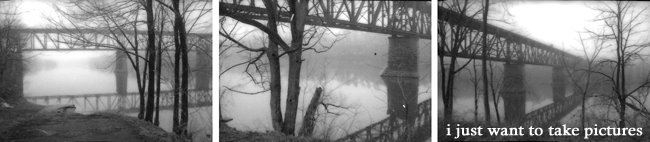
Thursday, June 11, 2009

They may graduate me yet...

An excerpt from "Mediations in Architecture and in the Urban Landscape" by Ignasi de Sola-Morales

Perhaps the veracity that we can concede to the media [graphic, literary, photographic], which enable us to acquire knowledge of architecture and urban landscapes, makes these media inescapable and essential to our approximation of this reality.
The production of the medium and the production of the experience are two facets of the same process. Architecture and the urban landscape are at the same time the medium and the result of this mediation that makes places out of non-places, form out of formlessness, intelligibility out of non-intelligibility, solidity out of fluidity.

Thus not only does our access to the experience of places necessarily pass through the media that make them accessible to us, this mediation is architecture itself. In other words, it is not only the necessity of mediation but also the mediatic condition, the establishing of fictions, that is intrinsic to architecture and the urban landscape.”

Wednesday, June 10, 2009

Intro... maybe.

One of the reasons I chose to complete my Masters of Architecture at the University of Waterloo was because of the incredible freedom the curriculum offered. Architecture's potential field of study is massive. I was seduced by the idea that I could take something I was passionate about and create a thesis.
I began my first term in January of 2008 thinking “I just want to take pictures,” convinced that there must be a way to relate photographs to architecture, or architecture to photographs. I spent almost an entire year trying to justify why I was taking pictures, what it had to do with architecture and what it all meant to me. There was no spark. I had tried to make the connection between photography and architecture via theory, and it all came to naught. After a very confusing couple of terms trying to figure out what Barthes could have possibly meant by “cameras are clocks for seeing” and how photography is related to time and death, I found myself, once again thinking, “I just want to take pictures”.
I finally settled on doing simply that: photographing. I would stop looking for a justification for picture taking, besides my desire to do so. I would stop trying to take an analytical and structured approach to the task of documenting the town. I began to wander streets; if something caught my I would photograph it. I did not care particularly where I ended up or how long I was out, as long as I had enough film. And, though not structured or pre-meditated, this wander became my format.

I soon discovered that it was that freedom to create, which I had been so excited about, that was actually what had crippled my progress. I felt I needed a reason for that creation – a justification. I began familiarizing myself with photographers - incredible photographers - like Walker Evans, Harry Callahan, Eugene Atget and Robert Frank. I read texts by Susan Sontag, Roland Barthes, Walter Benjamin, John Szarkowski and Stephen Shore, tapping into the minds of brilliant writers, hoping they had the answers I was looking for.
This determined search for a thesis only confused and disoriented me more.
I went through iterations of my abstract, week after week, and each time it seemed I was doing a different thesis. Nothing seemed to work, because I was doing things backwards. I would look for a suitable architecture thesis and only after that, would I attempt to incorporate photography. Since it hadn’t worked, I began to question if photography as a medium or topic had been the right choice.
When I finally decided to photograph, it would be through the experience of it, that I would locate my thesis and its relationship to architecture.

Words to use and to avoid

Words to Avoid:
- entitled
- essentially
- just
- but
- since
- however
- because
- one (as in 'one can see the effect....')

Words to Use
- perhaps (signals a jump to an interpretation. do not overuse)
- 'we' or 'the reader' (instead of one) - can be interchanged (carefully)

Outline

Begin by discussing my trouble with a photographic thesis (Journey):
  • Looking for the architecture in it
  • Trying to connect photography with architecture via theory
  • Asking ‘why can’t I just photograph?’
What is a photograph? (Event)
  • Index, trace
Why do people photograph?
  • Discuss Why People Photograph by Robert Adams
  • Discuss, in general, what previous photographers wanted to do with their work (Evans, Klein, Atget, Frank)
What does the photograph (& photography) mean to me?
  • Why is it important to me?
  • How does it help me as an architect?
  • What are some photographs that changed how I see the world, how I think, how I analyze?
  • Looking at the world through the camera - experience (before and after)
  • What do photographs reveal?
What is the public’s relationship with the image/picture/photograph and/or photographer?
  • Meaning
  • Truth