Showing posts with label questions. Show all posts

Saturday, June 27, 2009

Some ideas I am having trouble with...

“Thus not only does our access to the experience of places necessarily pass through the media that make them accessible to us, this mediation is architecture itself. In other words, it is not only the necessity of mediation but also the mediatic condition, the establishing of fictions, that is intrinsic to architecture and the urban landscape.”
Ignasi de Sola-Morales
Mediations in Architecture and in the Urban Landscape

The bolded line is essentially my thesis. But how do I explain that the mediation - the photograph, the written work regarding architecture is architecture itself..... ??? Or is that what I should be saying? It's so hard to try and sum up what the entire work is on through one such profound statement.

Helen Liggett sort of answers this in Urban Encounters, but I am still not sure if I understand it enough to explain in my own words.

“Both making and viewing images make new space… Viewing the photographic images becomes a mode with which to encounter the urban, not as a static environment, but as a boarding house with certain vacancies where temporal experience need only apply.”
Helen Liggett
Urban Encounters, 1993.

I am also trying to address 'the establishing of fictions' being intrinsic to architecture... fiction comes up again in a quote by Elias Torres:
"It is also true that through photographs fiction is greater, although reality might be more surprising.”

Those are two of my main issues right now.
a.

Wednesday, June 10, 2009

Outline

Begin by discussing my trouble with a photographic thesis (Journey):
  • Looking for the architecture in it
  • Trying to connect photography with architecture via theory
  • Asking ‘why can’t I just photograph?’
What is a photograph? (Event)
  • Index, trace
Why do people photograph?
  • Discuss Why People Photograph by Robert Adams
  • Discuss, in general, what previous photographers wanted to do with their work (Evans, Klein, Atget, Frank)
What does the photograph (& photography) mean to me?
  • Why is it important to me?
  • How does it help me as an architect?
  • What are some photographs that changed how I see the world, how I think, how I analyze?
  • Looking at the world through the camera - experience (before and after)
  • What do photographs reveal?
What is the public’s relationship with the image/picture/photograph and/or photographer?
  • Meaning
  • Truth

Tuesday, May 19, 2009

In light of our chat....

I have realized all the benefits of chatting with my colleagues at the school, in groups or one on one about the issues or dilemmas we are facing with our theses. It is amazing how much I have in my head, that hasn't been verbalized. Or I don't realize I know it unless I am asked a specific question and think I am blatantly making up an answer when all of a sudden it makes so much sense. I had a great chat with Vicky the other day over coffee, and hopefully our chat helped her as much as it helped me... afterwards I went through my notes and made a list of all the questions that I need to answer for myself to really help shape my thesis. Or some questions might make me realize that certain answers aren't important in regards to my thesis.
a.

Why do I have this strong idea about ‘no captions’ – about allowing the viewer, to choose, for himself, what the photograph means, is ‘saying, is of?
  • Does someone write about this relationship?
  • What do I think will change if I have captions?
I seem to have a very strong idea bout the relationship of the viewer and the photo
  • Where does this idea come from? (Sontag, Barthes?)
  • Will the experiences of the viewer change what he/she sees in my photo?
  • Will the conditions under which he see it affect his impression?
  • Does it remind him/her of a place/experience?
*What is the relationship (if there is one) between the viewer and the photographer? (Sontag & Barthes)

What is important in the ‘system’ of my photo-taking?
  • Wandering aimlessly vs. rigorous & thorough planning/exploration
  • How can I incorporate this ‘wandering’ idea into the thesis?
  • Am I getting too rigid with the structure of the thesis? (three parts: stories, pictures, buildings)
  • Should it be a flowing, wandering narrative/story/exploration?
What does it mean for the picture that it can be interpreted in many different ways?
  • What is different about pictures today?
  • How has that changed the way someone views an image?
Craft: Why manual darkroom work?
  • There is a certain personal relationship that is developed with each photo
  • The ‘building’ of each picture requires, testing, retesting, exploration, skill, observation and most of all patience
  • Define craft or craftsmanship
  • How is developing ‘physically’ w/ hands, different than using a computer digitally?
  • What is it about the creation of something w/ our hands?
  • Talk about the physical connection to the medium
  • Which part of the brain is active when this occurs?
As a whole, what are my photographs?
  • They are series of fragments of the city
  • Glimpses of well known and little known areas
  • They are an exploration of the town
  • Small ‘key map’ with location?
  • Does this benefit the viewer, the photograph?
The thesis is a photographic exploration/research of the town of Galt. (??? Is this it?)
  • Define a better thesis statement. In one sentence, what is my thesis?
Looking at the photos:
  • What are some recurring patterns?
  • List them
  • Look at each photograph and determine what it is about
  • Why does it work alone? Why doesn’t it?
  • Why is it that two (or three or more) photos are grouped together?
  • How does this change how these photos are seen?
  • What are some benefits to doing it this way?
  • Explain this by referring to specific images
  • Talk about mood/tone of a photo
  • What are the photos saying/showing us in terms of the city?
  • What will people walk away with after seeing the pictures?
  • Will they learn something?
  • What am I trying to tell/show them?
  • If this is a research of the city, what have I learned?
Make a matrix of photographs
  • Subject matter, composition (1/3, 2/3, 1/2, symmetrical), secondary & tertiary objects, direction of lines, sun angle/light, tone, texture
  • Map out where I have taken the photos

Monday, May 11, 2009

Why........

I was having a conversation with a colleague about her thesis the other day. In short, it is an incredible endeavour to design housing in a third world country based on the distribution of water, helping those displaced by war and other causes from their vilalges begin a new life in the city. The whole thing makes perfect sense. It uses a practical system that could be implemented over time, helping people better their quality of life.

These are the kinds of theses that could change lives.

And then I think of mine and I try to figure out what the point of it is... besides to earn a degree and to explore photography as it pertains to the architectural world around me. What am I contributing? To the school.. to architecture as a profession... to Galt? It seems that most people at the school see a problem, research on how they're going to fix it, and spend the next year designing a possible solution - as they see it, trying to make the world better.

Why do I always decide that I am going to do something 'different'? I get some crazy-ass idea that I am going to spend a year-and-a-half taking photos and run with it. My thesis hasn't really even figured out if it's a research thesis or some sort of convoluted 'design' thesis.

Sometimes, I frustrate myself with my stubbornnes to cause trouble (mainly for myself) and go against the norm. (Clearly today is one of those days).

I am learning to continually remind mysel of Don's statment: It's like chocolate. The world doesn't need it, but would be poorer without it.

That'll have to do. My thesis is chocolate. It's too late to go questioning the entire purpose of my thesis now. Or my entire purpose at the school. I'll save that for therapy.

Thursday, April 30, 2009

The thesis is.... the problem of what this is.


"Why" is the most subversive question. Don’t answer it.


Is the 'construction' of a print, something I want to document/include in the thesis?
Do I include contact sheets in the work? Are they my ‘sketches’ or diagrams?
Do I include copies of historical photographs or just my own?
What is the story I am trying to tell?
What does it have to do with architecture?
Where can I show my work? and can I do it in mid-July?
- Talk to Jeff L. about using one of the empty shops along Main Street.
Write about your obsessions....
What about the town fascinates me?
STARE at my photographs and find inspiration/stories within them
What does pattern recognition have to do with my photos/groups of photos?
- Rhetorical structure of photos
- Tarkovsky
- The group is an immediate lesson in how to see one image “This is the quintessential photograph of this one”
What happens with the individual photos?
What am I getting out of this?

Tuesday, March 24, 2009

Formulating an Abstract + some Advice

Questions to help formulate an abstract:
  • What am I doing?
  • Why am I doing it?
  • How am I doing it?
  • What do I hope to find?
  • What will the significance be?
What am I doing?
I am taking pictures of Galt.
The object of study can be the subject of study - architecture.

Why am I doing it?
I wish "Why not?" could count as an answer....
I am doing it because I want to take beautiful photographs. I want to explore the city and document it, find places that are poignant, unexpected (or expected), have something to say, or sit quietly in the background. I want to record history. There are a lot of "I want"s in this paragraph.. the simple answer really is, "Because I want to."

How am I doing it?
I am using a 35mm Pentax and a 120mm Mamiya, black and white film (100 speed) and developing the images in the darkroom myself. I wander around the town, trying to explore different areas and document them. I return to places I believe have character that perhaps I haven't been able to capture yet or places I would like to visit in various lighting conditions. There is no set way in how I explore the town. It's a bit of a meandering wander - I end up where I end up.

*In the last couple days as I have been posting negatives and other images on this blog, I have realized just how much time I have been, am now and will be devoting the actual enlargement of these negatives in the darkroom. Having gone through about 30 photographs in a matter of hours, touched up quickly, fixed scratches - it really made me look hard as to why I have decided to physically and manually (and painstakingly) develop my images. For now, my answer is - for the craft. It really is about the priviledge of being so closely involved with the images - of spending hours in a dark room perfecting each corner of a photo until it all comes together to form the final print.

What do I hope to find?
I'm not sure if there is anything in particular that I am looking for. I think the idea is more about bringing together a cohesive image or depiction of the town - by seeing photo after photo, I hope to take viewers on a walk through the town, follow in my footsteps and see (through my eyes) what I have seen.

What will the significance be?
This is the question I am having the most trouble with. In the grand scheme of things, this is not a redesign for the better of a city core.... or research into social housing and making the lives of people better. It is art for art's sake, as well as, being about the town. It is about presenting Galt to a greater audience and in a different light than perhaps it has been perceived in the past (see the last quote at the bottom of the post).

Advice
At my Mx reviews last fall, there were a couple quotes by the professors, during my crit and the one previous to it, which I wrote down. I can't remember who it was that said what, but some I remembered, so I credited.

About progress...
"become OBSESSED" Geoff
"Don't be good. Everything/everyone is a subject" Don to me
"Project the project forward - don't be meek. 'Here's my MASSIVE idea'"

About the outcome...
"What do I want the result to look like?" (work backwords)
"Who's work do you most wish your work could be like?"
"Which project do you most desire yours looked like right now?"
"This isn't your last project, it's your first project." Geoff

About titles...
"'Adaptive reuse' is a healthy meal. 'Wallowing in shit' is a feast!'" (Don)
"Think of a name you could put in italics"

My favourite quote was from Geoff, and it really hit home in terms of what I want to achieve:
"Tell the town what it has not seen of itself."

Monday, March 23, 2009

Why Photography?

The last couple weeks, I have sat down several times to write what I was thinking, try and explain to myself why I am doing what I'm doing. The format is very informal, as I was basically talking to myself and recording the conversation.

Why take photos of Galt?
I wanted to take photographs of Galt because of the incredible history in this town. In such a short period, it's gone from being dubbed "the Manchester of Canada" to presently being swallowed up by the City of Cambridge, not to mention the Region of Waterloo. It is mainly bypassed and driven through. Most of the old buildings have stood their time having only changed tenants - many of them are falling apart and are in serious need of repair. The CIBC building is an exception, having been the first tenant in the building at the corner of water and main and remaining there today (after an interior renovation in the 60's).

I feel there is a change coming to the town and, though slowly, it's on its way back up again. The demise of the Royal Hotel and its current rebuilding gives me that idea. There is something to be said for someone who invests so much money in a building that would have been much cheaper to simply tear down. There is history here. And, though, selling crack through a hole in the wall in the bathroom may not be anything to brag about, it is part of the texture that makes up the history of this town, and helps define the town as it stands.

Why do I want to take photos?
The first reaction that comes to mind is that I don't just want to take any photos, I want to take beautiful photos. I want to find the beauty that lies in this town, some of it obvious and some of it not. And though one begs to question whether something is beautiful because it is photographed or whether it is photographed because it is beautiful, I am not sure I am ready to answer that question in this thesis or whether or not it is my responsibility to do so. Light, shadow, texture and form do an amazing job to create beauty in places where it may not be typically present.

I almost feel that taking photos of ruins, and abandoned buildings is a somewhat cliché, an image I don't want to be tied to. But, on the other hand, there is incredible beauty in things that have been abandoned, worn down by weather, changing and existing on their own.

There are those other things, like cheap subdivisions and condos, buildings built and created solely to cash in on a portion of the money that has somehow been slowly coming back to the town since the school moved in. And though, I don't find those buildings beautiful, I do find the images of them moving, or telling. They also make up a part of this town, its present history, and since I do not believe they are a good idea, lack character, quality and all the things that make good architecture, I believe juxtaposing them with the defiant structures of the original town, gives them an incredibly weak, almost laughable, image.

The houses in the various areas around the downtown core amuse me. There are the mansions in West Galt - beautiful old buildings, full of character and amazing workmanship. Some, though, are still ridiculously monumental for the sole purpose of being a residence to a single family. On the east side of Galt is another hill - old houses again, not nearly as monumental, still filled with character - though many of them more so from their owners and tenants rather than their architectural appeal.

The 1950's neighbourhood to the South of Concession Street is almost surreal. Though I am used to seeing townhouses and condos, all lined up like ducks in a row, not knowing one from the next, the small 900 square foot symmetrical boxes line the streets so identically, it becomes somewhat rhythmic and soothing.

In between all these distinct classes are a mish-mash of beautiful houses amid incredible trash - homes with terrible proportions, vinyl siding galore, and of course, 'furnished' porches and kitsch strewn yards.

Sometimes, depending on the light, incredible shapes, forms, textures and scenes emerge from these random places, weaving together the characters that make up the town.

Where are all the people?
I have never had any inclination to take pictures of individuals – people are too unpredictable, and I enjoy the patience I can employ while waiting for the light right, trying the image from a different angle. Also with all the red tape involved with taking photographs of people, I rather stay away from the whole thing. I have become much more brave at approaching people’s homes, backyards and properties in general to photograph them, but photographing people is still beyond my realm of courage. (Unless I do it the Walker Evans way and release my photos ten years later in fear of being sued). There is a certain amount of control which must be relinquished when photographing people.

There is constancy in buildings – something to always expect, and yet something to always be surprised by. Though I may see a building a hundred times, passing it on the street daily, there can be one instance in which, it shows itself in a different light (pun intended), and everything about it changes. It is my responsibility (and privilege) to experience and capture that exact moment, if I am prepared and capable.

What does it mean to take a photograph?
Being a photographer, I immediately believe that the photograph belongs to the person who captured it with his or her camera. There is no doubt in my mind that buildings, once built, are in the public domain. They are in the street, they are viewed every day, there is no reason why someone, for whatever reason, cannot take a photograph. Wallpaper, clothing – anything that is designed, at one point ‘belongs’ to the designer, but after it is released for others to purchase, to see, to interact with – the designer relinquishes his or her control. Arguably, someone inevitably owns the building and the actual property on which it sits, and so they can control photography taken inside. Unless there is some sort of security threat, they, I do not believe, have the right to control the taking of photographs.

Though I tend to think the same when photographing a person, I am sure I would be of a different opinion if the photo in question were of me. In an intimate setting, yes I think there is an issue of privacy, defamation is possible and many other issues. But out in the public domain, with the mass production of cameras and camera phones, one cannot expect to never end up in a strangers photo. And though entering the frame could be completely accidental, or staged and patiently expected by the photographer, neither, I believe, should be an issue. There is the, obviously, the problem of people who are ill and take photos for personal use and abuse, but this, I think, begins a more political discussion. You can’t control a person like that, but you can control your own actions. I have had my photo taken randomly by a camera phone on a bus, and found it incredibly creepy – but I simply moved away from the person and out of their view.

The reason for many tribes in North African (?) countries and elsewhere to fear photography is pretty simple and really quite understandable. Their belief system explains our souls, our essential being, as having a multitude of layers. When a photograph is taken, one of those layers is trapped within the photograph to create that image and so the subject is one layer closer to ceasing to exist. This belief is actually very close to what Sontag and Barthes spoke of when they referred to the light emanating off a photograph. The exact light that took the photograph of a missing person was absorbed by the camera, which then recorded that photo. That light produced that photo and now allowed Barthes and Sontag to see the image of that person, linking them physically to the person through light.

Composition
What many people are not aware of is the incredible work that occurs in the dark room after the photo is taken. I completed two final prints today – my first two out of approximately sixty to come. And, for the first print, there must be at least twenty scrap test sheets – puzzle pieces that make up the complex areas of the photo, those that have to be tested and retested, burned or dodged. Within every photo that is printed, each area of shadow or light has to be tested, compared, altered – discovered. To make the final composition work, look as coherent and beautiful as it possibly can, many different components have to be finalized first.

I had an incredible day when I was working on my first print – still messing around with shadows and trying to find information in areas of light. I decided, upon the advice of my mentor, to risk it – to risk exposing the light area too much, rather than not enough. If I had decided to only expose it a little bit longer than I had already done, hoping there would be more information, I would never know what information could possibly be lying in the image if I exposed to, say, twice the amount of time as I had previously done. And, amazingly enough, I discovered shadows where previously I thought there were none! It seems quite ridiculous, but it was an incredible find as it brought that portion of the image alive – dancing tree branches on an old and rusty front door – one more piece of the puzzle was complete.

There is a very obvious connection with design in this entire process – once in the darkroom the composition of the photograph becomes a design of components. You must first perfect each component, but, all the while, keeping in mind how it will compare with the rest of the image. You may discover that an area seems too light, missing information, looking slightly under exposed. But, after having exposed that small piece of the picture longer, you find that the whole image now seems colder, less inviting. You discover that, even though on its own the small area seemed much too bright, in the whole of the picture it actually provided a ray of sunlight, of warmth – a destination for the viewer, where he or she could image themselves sitting on a tattered sofa on a porch, basking in the afternoon sun. By taking away that warmth, you change the atmosphere of the photograph and its connection to the viewer.

I have learned to underexpose the shadows and over expose the light – information lurks in areas you would not expect and though our eyes are complex enough to be able to pick out these tonal changes and hidden information, the camera lenses are not capable to see what we see. It is our job to then find what the camera cannot see – or does not know it sees.
Recent Questions

In the last meeting these were some questions that were asked me. I'm still working on the answers to them.
  • What does it mean to take a photo?
  • Who am I taking it from?
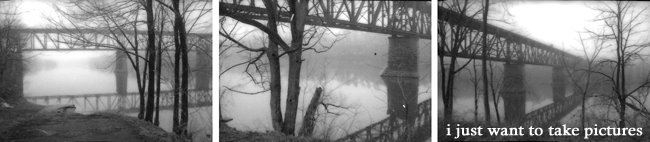
  • Why can't I just take a picture?
  • Why this instant? Why press the shutter just then?
  • Why do I want to take photos?
a.