Questions to help formulate an abstract:
- What am I doing?
- Why am I doing it?
- How am I doing it?
- What do I hope to find?
- What will the significance be?
What am I doing?
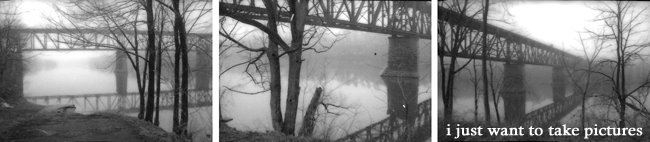
I am taking pictures of Galt.
The object of study can be the subject of study - architecture.
Why am I doing it?
I wish "Why not?" could count as an answer....
I am doing it because I want to take beautiful photographs. I want to explore the city and document it, find places that are poignant, unexpected (or expected), have something to say, or sit quietly in the background. I want to record history. There are a lot of "I want"s in this paragraph.. the simple answer really is, "Because I want to."
How am I doing it?
I am using a 35mm Pentax and a 120mm Mamiya, black and white film (100 speed) and developing the images in the darkroom myself. I wander around the town, trying to explore different areas and document them. I return to places I believe have character that perhaps I haven't been able to capture yet or places I would like to visit in various lighting conditions. There is no set way in how I explore the town. It's a bit of a meandering wander - I end up where I end up.
*In the last couple days as I have been posting negatives and other images on this blog, I have realized just how much time I have been, am now and will be devoting the actual enlargement of these negatives in the darkroom. Having gone through about 30 photographs in a matter of hours, touched up quickly, fixed scratches - it really made me look hard as to why I have decided to physically and manually (and painstakingly) develop my images. For now, my answer is - for the craft. It really is about the priviledge of being so closely involved with the images - of spending hours in a dark room perfecting each corner of a photo until it all comes together to form the final print.
What do I hope to find?
I'm not sure if there is anything in particular that I am looking for. I think the idea is more about bringing together a cohesive image or depiction of the town - by seeing photo after photo, I hope to take viewers on a walk through the town, follow in my footsteps and see (through my eyes) what I have seen.
What will the significance be?
This is the question I am having the most trouble with. In the grand scheme of things, this is not a redesign for the better of a city core.... or research into social housing and making the lives of people better. It is art for art's sake, as well as, being about the town. It is about presenting Galt to a greater audience and in a different light than perhaps it has been perceived in the past (see the last quote at the bottom of the post).
Advice
At my Mx reviews last fall, there were a couple quotes by the professors, during my crit and the one previous to it, which I wrote down. I can't remember who it was that said what, but some I remembered, so I credited.
About progress...
"become OBSESSED" Geoff
"Don't be good. Everything/everyone is a subject" Don to me
"Project the project forward - don't be meek. 'Here's my MASSIVE idea'"
About the outcome...
"What do I want the result to look like?" (work backwords)
"Who's work do you most wish your work could be like?"
"Which project do you most desire yours looked like right now?"
"This isn't your last project, it's your first project." Geoff
About titles...
"'Adaptive reuse' is a healthy meal. 'Wallowing in shit' is a feast!'" (Don)
"Think of a name you could put in italics"
My favourite quote was from Geoff, and it really hit home in terms of what I want to achieve:
"Tell the town what it has not seen of itself."
I am taking pictures of Galt.
The object of study can be the subject of study - architecture.
Why am I doing it?
I wish "Why not?" could count as an answer....
I am doing it because I want to take beautiful photographs. I want to explore the city and document it, find places that are poignant, unexpected (or expected), have something to say, or sit quietly in the background. I want to record history. There are a lot of "I want"s in this paragraph.. the simple answer really is, "Because I want to."
How am I doing it?
I am using a 35mm Pentax and a 120mm Mamiya, black and white film (100 speed) and developing the images in the darkroom myself. I wander around the town, trying to explore different areas and document them. I return to places I believe have character that perhaps I haven't been able to capture yet or places I would like to visit in various lighting conditions. There is no set way in how I explore the town. It's a bit of a meandering wander - I end up where I end up.
*In the last couple days as I have been posting negatives and other images on this blog, I have realized just how much time I have been, am now and will be devoting the actual enlargement of these negatives in the darkroom. Having gone through about 30 photographs in a matter of hours, touched up quickly, fixed scratches - it really made me look hard as to why I have decided to physically and manually (and painstakingly) develop my images. For now, my answer is - for the craft. It really is about the priviledge of being so closely involved with the images - of spending hours in a dark room perfecting each corner of a photo until it all comes together to form the final print.
What do I hope to find?
I'm not sure if there is anything in particular that I am looking for. I think the idea is more about bringing together a cohesive image or depiction of the town - by seeing photo after photo, I hope to take viewers on a walk through the town, follow in my footsteps and see (through my eyes) what I have seen.
What will the significance be?
This is the question I am having the most trouble with. In the grand scheme of things, this is not a redesign for the better of a city core.... or research into social housing and making the lives of people better. It is art for art's sake, as well as, being about the town. It is about presenting Galt to a greater audience and in a different light than perhaps it has been perceived in the past (see the last quote at the bottom of the post).
Advice
At my Mx reviews last fall, there were a couple quotes by the professors, during my crit and the one previous to it, which I wrote down. I can't remember who it was that said what, but some I remembered, so I credited.
About progress...
"become OBSESSED" Geoff
"Don't be good. Everything/everyone is a subject" Don to me
"Project the project forward - don't be meek. 'Here's my MASSIVE idea'"
About the outcome...
"What do I want the result to look like?" (work backwords)
"Who's work do you most wish your work could be like?"
"Which project do you most desire yours looked like right now?"
"This isn't your last project, it's your first project." Geoff
About titles...
"'Adaptive reuse' is a healthy meal. 'Wallowing in shit' is a feast!'" (Don)
"Think of a name you could put in italics"
My favourite quote was from Geoff, and it really hit home in terms of what I want to achieve:
"Tell the town what it has not seen of itself."


